What would be required for a successful European frontier AI project?
What would be required for a successful European frontier AI project?
The transformative AI strategy laid out in the previous sections does not include a recommendation for Europe to develop its own frontier AI models. Rather, it is a leverage-first strategy outlining how Europe can make itself irreplaceable in as many other layers of the AI value chain as possible and use that leverage to secure frontier model access and a stake in decisions over how this technology gets built. This is because, while per se highly desirable, truly catching up to the accelerating frontier would be politically and financially vastly more costly than any measures currently discussed in mainstream European AI policy.
However, in light of concerns about the recent access restrictions on some US frontier models, some European policymakers and experts have expressed renewed concern that betting on being able to negotiate guaranteed access to foreign frontier AI might be too risky. Commission President Ursula von der Leyen, for example, said when presenting the European Technological Sovereignty Package that Europe “cannot afford to depend on others for the technologies that keep our hospitals running, our energy grids stable, and our services secure.”
Both a ‘Leverage Approach’ (as discussed in the previous sections) and a ‘European Frontier AI Project Approach’ are valid approaches for Europe to try to regain a position of strength in AI. Both require extraordinary political resolve and urgency given the several exponential trends discussed in the sections above. The European Frontier AI Project Approach has obvious political appeal over and above the Leverage Approach, but it also requires even more political and financial capital to even stand a serious chance of succeeding. A half-hearted attempt at a European frontier AI project consisting of bold political statements and ambitions but not backed up by the extraordinary resolve and resources required would lead Europe down the worst of all possible paths: still without domestic frontier AI capabilities, and without reliable ways to use other leverage to secure access to foreign frontier AI. Based on the past few years, this seems to be the default trajectory: The hopes of catching up to the frontier and thus achieving European sovereignty at the model layer have absorbed considerable political capital and attention, but not come close to being pursued with the resolve and resources needed to succeed.
Internalising this is crucial for European sovereignty and prosperity. Catching up to the frontier is in principle possible, but with US hyperscalers spending more than the equivalent of the Manhattan Project every month in today’s money, doing so will be very expensive. As this section discusses, a serious attempt with a significant chance of succeeding would likely cost Europe approximately €790 billion over the first three years of such a project and would require a reordering of European industrial priorities as well as the commitment of most of Europe's leverage to a single, risky undertaking (see Cost summary).
The potential upside of safely developing such models in Europe, including the boost to European competitiveness and sovereignty, and the risk of losing access to frontier AI are both sufficiently high to justify such a bet, especially as European leverage to secure access to foreign frontier AI wanes over time. However, taking this bet is reasonable only if the right political conditions, described in this section, are in place. If those conditions are not in place in the near future, European decision-makers should pursue the default strategy presented in the other sections of this document, which, if executed with ambition and resolve, has a good chance of ensuring European competitiveness, sovereignty, and security as much as possible even in transformative AI scenarios. Efforts to develop domestic frontier models that are not backed up by the necessary level of ambition would leave Europe in the worst of all worlds.
This section lays out the conditions under which a European frontier project is a bet worth making, the best way for Europe to attempt this project if those conditions were met, and which of the main recommendations from the previous part of this strategy would change if Europe tried a European frontier project.
The transformative AI strategy laid out in the previous sections does not include a recommendation for Europe to develop its own frontier AI models. Rather, it is a leverage-first strategy outlining how Europe can make itself irreplaceable in as many other layers of the AI value chain as possible and use that leverage to secure frontier model access and a stake in decisions over how this technology gets built. This is because, while per se highly desirable, truly catching up to the accelerating frontier would be politically and financially vastly more costly than any measures currently discussed in mainstream European AI policy.
However, in light of concerns about the recent access restrictions on some US frontier models, some European policymakers and experts have expressed renewed concern that betting on being able to negotiate guaranteed access to foreign frontier AI might be too risky. Commission President Ursula von der Leyen, for example, said when presenting the European Technological Sovereignty Package that Europe “cannot afford to depend on others for the technologies that keep our hospitals running, our energy grids stable, and our services secure.”
Both a ‘Leverage Approach’ (as discussed in the previous sections) and a ‘European Frontier AI Project Approach’ are valid approaches for Europe to try to regain a position of strength in AI. Both require extraordinary political resolve and urgency given the several exponential trends discussed in the sections above. The European Frontier AI Project Approach has obvious political appeal over and above the Leverage Approach, but it also requires even more political and financial capital to even stand a serious chance of succeeding. A half-hearted attempt at a European frontier AI project consisting of bold political statements and ambitions but not backed up by the extraordinary resolve and resources required would lead Europe down the worst of all possible paths: still without domestic frontier AI capabilities, and without reliable ways to use other leverage to secure access to foreign frontier AI. Based on the past few years, this seems to be the default trajectory: The hopes of catching up to the frontier and thus achieving European sovereignty at the model layer have absorbed considerable political capital and attention, but not come close to being pursued with the resolve and resources needed to succeed.
Internalising this is crucial for European sovereignty and prosperity. Catching up to the frontier is in principle possible, but with US hyperscalers spending more than the equivalent of the Manhattan Project every month in today’s money, doing so will be very expensive. As this section discusses, a serious attempt with a significant chance of succeeding would likely cost Europe approximately €790 billion over the first three years of such a project and would require a reordering of European industrial priorities as well as the commitment of most of Europe's leverage to a single, risky undertaking (see Cost summary).
The potential upside of safely developing such models in Europe, including the boost to European competitiveness and sovereignty, and the risk of losing access to frontier AI are both sufficiently high to justify such a bet, especially as European leverage to secure access to foreign frontier AI wanes over time. However, taking this bet is reasonable only if the right political conditions, described in this section, are in place. If those conditions are not in place in the near future, European decision-makers should pursue the default strategy presented in the other sections of this document, which, if executed with ambition and resolve, has a good chance of ensuring European competitiveness, sovereignty, and security as much as possible even in transformative AI scenarios. Efforts to develop domestic frontier models that are not backed up by the necessary level of ambition would leave Europe in the worst of all worlds.
This section lays out the conditions under which a European frontier project is a bet worth making, the best way for Europe to attempt this project if those conditions were met, and which of the main recommendations from the previous part of this strategy would change if Europe tried a European frontier project.
Starting conditions
Starting conditions
Form a coalition of aligned countries
Form a coalition of aligned countries
No government acting alone could fund a project intended to reach the AI frontier. Even under favourable conditions, only a committed bloc of countries would be able to mobilise the required resources and withstand the likely political pressure: Since a middle-power-led frontier project could run counter to US interests, it should anticipate attempts by the US government to slow down or even prevent the effort, either through AI-specific measures or escalation in adjacent domains, such as security cooperation and trade.
A coalition of liberal democracies, anchored in Europe, is the most promising starting point to address these challenges. Among likely participants, Europe itself retains the largest economic, industrial, and fiscal base and is the largest established political bloc. As such, it would be the natural foundation of a frontier project. By adding relevant assets, the participation of other countries would increase the likelihood of success: Canada and the United Kingdom could contribute technical talent, while the United Kingdom also has substantial state capacity. Japan and South Korea would add further economic weight and important positions in the semiconductor supply chain. Australia, Canada, and Norway could provide attractive locations for large-scale compute infrastructure.
However, there is a trade-off between coalition scale and political cohesion. Internal fragmentation would pose a major risk to coordinated action, and the withdrawal of any one member could introduce further instability into an already fragile arrangement. It would therefore be dangerous to define the coalition too broadly at the outset by including governments that are not firmly committed, only to lose them later. This risk would be compounded by strong US incentives to target individual participants bilaterally and induce them to defect. For example, if the US offered a close ally, such as the United Kingdom, large-scale data centre investment and a broad exemption from export controls, that ally might plausibly accept that offer. Close allies might also decline to join at the outset and instead pursue bilateral engagement with the US. Given the current state of bilateral relationships and the importance of US security guarantees, South Korea, Japan, and the United Kingdom are unlikely to be reliable participants in a European-led coalition, unless political conditions change (for example through further restrictions on US frontier models, which could lead more participants to join the coalition).
The most likely founding alliance would therefore consist of value-aligned governments able to make substantial contributions: the European Union, Canada, and Australia. Participation should remain open to the United Kingdom, Japan, and South Korea if their strategic assessments change, while structured cooperation should be offered to close partners such as Norway, Switzerland, and New Zealand. The coalition would require a strong and binding commitment mechanism, as defection remains a risk even within this narrower group. One straightforward approach, although politically difficult, would be to require members to commit a majority of their funding, talent, and infrastructure access in forms that could not easily be withdrawn following a change in policy. Other interested governments could contribute funding in exchange for guaranteed access rights below those of full coalition members, but should not receive constituent voting rights, in order to preserve an effective decision-making structure.
No government acting alone could fund a project intended to reach the AI frontier. Even under favourable conditions, only a committed bloc of countries would be able to mobilise the required resources and withstand the likely political pressure: Since a middle-power-led frontier project could run counter to US interests, it should anticipate attempts by the US government to slow down or even prevent the effort, either through AI-specific measures or escalation in adjacent domains, such as security cooperation and trade.
A coalition of liberal democracies, anchored in Europe, is the most promising starting point to address these challenges. Among likely participants, Europe itself retains the largest economic, industrial, and fiscal base and is the largest established political bloc. As such, it would be the natural foundation of a frontier project. By adding relevant assets, the participation of other countries would increase the likelihood of success: Canada and the United Kingdom could contribute technical talent, while the United Kingdom also has substantial state capacity. Japan and South Korea would add further economic weight and important positions in the semiconductor supply chain. Australia, Canada, and Norway could provide attractive locations for large-scale compute infrastructure.
However, there is a trade-off between coalition scale and political cohesion. Internal fragmentation would pose a major risk to coordinated action, and the withdrawal of any one member could introduce further instability into an already fragile arrangement. It would therefore be dangerous to define the coalition too broadly at the outset by including governments that are not firmly committed, only to lose them later. This risk would be compounded by strong US incentives to target individual participants bilaterally and induce them to defect. For example, if the US offered a close ally, such as the United Kingdom, large-scale data centre investment and a broad exemption from export controls, that ally might plausibly accept that offer. Close allies might also decline to join at the outset and instead pursue bilateral engagement with the US. Given the current state of bilateral relationships and the importance of US security guarantees, South Korea, Japan, and the United Kingdom are unlikely to be reliable participants in a European-led coalition, unless political conditions change (for example through further restrictions on US frontier models, which could lead more participants to join the coalition).
The most likely founding alliance would therefore consist of value-aligned governments able to make substantial contributions: the European Union, Canada, and Australia. Participation should remain open to the United Kingdom, Japan, and South Korea if their strategic assessments change, while structured cooperation should be offered to close partners such as Norway, Switzerland, and New Zealand. The coalition would require a strong and binding commitment mechanism, as defection remains a risk even within this narrower group. One straightforward approach, although politically difficult, would be to require members to commit a majority of their funding, talent, and infrastructure access in forms that could not easily be withdrawn following a change in policy. Other interested governments could contribute funding in exchange for guaranteed access rights below those of full coalition members, but should not receive constituent voting rights, in order to preserve an effective decision-making structure.
Set up a new private company
Set up a new private company
A private company alone could not develop a frontier model on behalf of the coalition without sustained governmental support. Even in the US, the trend is moving toward stronger government involvement in the AI industry, despite a vital and well-capitalised private ecosystem. A European-led coalition lacks the venture capital market to create a frontier company organically, and it does not have the time to build this market from scratch. If the trend towards securitisation continues in the US, by the time that Europe has a private frontier company up and running, the US will likely have taken equity stakes in its leading AI developers and interlinked them with the intelligence community. The coalition’s private sector champion would thus be competing at least partly with the US government. Finally, any private company would have to be registered in one country and would be open to suspicion of state favouritism.
Instead, a frontier project needs the full backing of the coalition countries, including the support of their national security authorities to protect it from foreign interference, the full support of their trade authorities to secure the supply chains, and the full support of their treasuries to finance it.
A private company alone could not develop a frontier model on behalf of the coalition without sustained governmental support. Even in the US, the trend is moving toward stronger government involvement in the AI industry, despite a vital and well-capitalised private ecosystem. A European-led coalition lacks the venture capital market to create a frontier company organically, and it does not have the time to build this market from scratch. If the trend towards securitisation continues in the US, by the time that Europe has a private frontier company up and running, the US will likely have taken equity stakes in its leading AI developers and interlinked them with the intelligence community. The coalition’s private sector champion would thus be competing at least partly with the US government. Finally, any private company would have to be registered in one country and would be open to suspicion of state favouritism.
Instead, a frontier project needs the full backing of the coalition countries, including the support of their national security authorities to protect it from foreign interference, the full support of their trade authorities to secure the supply chains, and the full support of their treasuries to finance it.
Use previously successful institutional designs for developing frontier AI
Use previously successful institutional designs for developing frontier AI
Despite the need for government support, the vehicle responsible for executing a European frontier AI project should still be a private company. This company requires a highly empowered leadership group, selected on the basis of exceptional and demonstrated research judgement, experience building and scaling very large organisations, and an ability to communicate effectively with funders – which, in this case, would primarily mean a broad group of participating governments.
Below this founding team, the organisation would largely resemble today’s most successful frontier AI developers. There is limited scope to experiment with alternative institutional forms: The private frontier developer model is the only structure that has so far demonstrated an ability to produce frontier AI systems. The location of the vehicle would be politically sensitive; ideally, its operations are distributed across several cities, both to accommodate the location preferences of scarce technical talent and to reduce concentration risk in any single jurisdiction. A distributed structure would also spread some of such a project’s secondary economic benefits, including stimulation of local ecosystems and taxable income associated with salaries and infrastructure.
Existing teams from interested European and partner-country companies could be incorporated into this vehicle. European AI developers represent valuable concentrations of talent and initial expertise. However, a European frontier project could not be built around any of their existing corporate structures. European companies have not been able to reach the frontier so far, and so they are unlikely to recruit enough of the critical talent required for this. Top-tier researchers would be more likely to join a new organisation established with the explicit, government-backed goal of reaching the frontier. Acquiring approximately half of the relevant companies from coalition countries – including the teams, intellectual property and valuable data – at close to current valuations could account for roughly €25 billion of such a project’s total cost.
Since the vehicle would depend on very large-scale government support, and since governments would have legitimate interests in its approach to safety and security, the private company should be mirrored by a complementary government structure. This structure should remain institutionally separate from the vehicle’s technical operations, to prevent bureaucratic processes from slowing execution and turning such a project into a conventional government programme. Each participating country should instead appoint a senior project lead at ministerial or state-secretary level who is capable of navigating the relevant national political institutions. These leads should be supported by high-calibre teams of frontier AI policy specialists, similar in structure and composition to the United Kingdom taskforce that subsequently became the world’s first AI Security Institute. The national leads and their teams would act as the main interface between the frontier project and its constituent governments. They would manage communications, translate between technical and policy language, ensure that the project respects non-negotiable political constraints, and ensure that governments understand when their interventions risk impeding execution. The quality of these government links would be central to such a project’s political durability.
Despite the need for government support, the vehicle responsible for executing a European frontier AI project should still be a private company. This company requires a highly empowered leadership group, selected on the basis of exceptional and demonstrated research judgement, experience building and scaling very large organisations, and an ability to communicate effectively with funders – which, in this case, would primarily mean a broad group of participating governments.
Below this founding team, the organisation would largely resemble today’s most successful frontier AI developers. There is limited scope to experiment with alternative institutional forms: The private frontier developer model is the only structure that has so far demonstrated an ability to produce frontier AI systems. The location of the vehicle would be politically sensitive; ideally, its operations are distributed across several cities, both to accommodate the location preferences of scarce technical talent and to reduce concentration risk in any single jurisdiction. A distributed structure would also spread some of such a project’s secondary economic benefits, including stimulation of local ecosystems and taxable income associated with salaries and infrastructure.
Existing teams from interested European and partner-country companies could be incorporated into this vehicle. European AI developers represent valuable concentrations of talent and initial expertise. However, a European frontier project could not be built around any of their existing corporate structures. European companies have not been able to reach the frontier so far, and so they are unlikely to recruit enough of the critical talent required for this. Top-tier researchers would be more likely to join a new organisation established with the explicit, government-backed goal of reaching the frontier. Acquiring approximately half of the relevant companies from coalition countries – including the teams, intellectual property and valuable data – at close to current valuations could account for roughly €25 billion of such a project’s total cost.
Since the vehicle would depend on very large-scale government support, and since governments would have legitimate interests in its approach to safety and security, the private company should be mirrored by a complementary government structure. This structure should remain institutionally separate from the vehicle’s technical operations, to prevent bureaucratic processes from slowing execution and turning such a project into a conventional government programme. Each participating country should instead appoint a senior project lead at ministerial or state-secretary level who is capable of navigating the relevant national political institutions. These leads should be supported by high-calibre teams of frontier AI policy specialists, similar in structure and composition to the United Kingdom taskforce that subsequently became the world’s first AI Security Institute. The national leads and their teams would act as the main interface between the frontier project and its constituent governments. They would manage communications, translate between technical and policy language, ensure that the project respects non-negotiable political constraints, and ensure that governments understand when their interventions risk impeding execution. The quality of these government links would be central to such a project’s political durability.
Put in place sufficient public budget funding
Put in place sufficient public budget funding
Once established, the vehicle would need to be sufficiently capitalised. As a rough approximation, a European frontier AI project could cost approximately €790 billion over three years. The figures in this section are stated in euros, but the principal inputs – including chips, construction, and frontier talent – are largely priced in dollars. The estimates therefore carry exchange-rate risk in addition to the underlying general uncertainty. The figures presented here and in the following sections should therefore be understood as order-of-magnitude estimates, benchmarked against available sources, such as disclosed spending by leading US developers and filings disclosing rental compute contracts. A consolidated ledger is provided at the end of the chapter.
Financing would need to come primarily from public budgets and dedicated debt instruments rather than from the private sector. European and allied governments retain substantial borrowing capacity, and a successful frontier project could eventually generate significant revenues. Until then, coalition governments would need to establish the legislative and executive mechanisms required to enable public investment. Treasuries, pension funds, sovereign wealth funds, and related institutions would provide direct funding where necessary. Over time, a European frontier project should seek to attract substantial private capital. Established industries across participating countries have significant financial resources and a strong interest in gaining exposure to AI, and could be offered preferential access, model fine-tuning, or other commercial advantages in exchange for investment. The coalition should not, however, assume that private financing will be available at the required scale. The working assumption is that participating countries will bear most of the initial three-year cost.
The principal advantage of this model is that it creates a public ownership structure. Governments would absorb a European frontier project’s early strategic and financial risk, while retaining ownership of the frontier company. Such companies can command very high valuations, and the sovereign equity generated by a successful European project would later become a significant public asset. In this sense, a European frontier project would be a highly concentrated and risky sovereign investment rather than pure fiscal expenditure. If it succeeded, the company could subsequently be privatised through European capital markets, subject to strategically acceptable limits on private ownership. Participating treasuries could thereby recover part of their initial investment through staged public offerings. Restrictions on the early withdrawal or sale of public equity would also serve as a commitment mechanism: A member that withdrew before completion would forfeit part or all of its initial contribution.
The overall cost of a European frontier project would be substantial but within the fiscal capacity of the proposed coalition. It would be comparable in scale to special debt packages previously undertaken by countries such as Germany, while being distributed across a much broader group. The principal constraint is thus not fiscal capacity, but a sustained political commitment.
Once established, the vehicle would need to be sufficiently capitalised. As a rough approximation, a European frontier AI project could cost approximately €790 billion over three years. The figures in this section are stated in euros, but the principal inputs – including chips, construction, and frontier talent – are largely priced in dollars. The estimates therefore carry exchange-rate risk in addition to the underlying general uncertainty. The figures presented here and in the following sections should therefore be understood as order-of-magnitude estimates, benchmarked against available sources, such as disclosed spending by leading US developers and filings disclosing rental compute contracts. A consolidated ledger is provided at the end of the chapter.
Financing would need to come primarily from public budgets and dedicated debt instruments rather than from the private sector. European and allied governments retain substantial borrowing capacity, and a successful frontier project could eventually generate significant revenues. Until then, coalition governments would need to establish the legislative and executive mechanisms required to enable public investment. Treasuries, pension funds, sovereign wealth funds, and related institutions would provide direct funding where necessary. Over time, a European frontier project should seek to attract substantial private capital. Established industries across participating countries have significant financial resources and a strong interest in gaining exposure to AI, and could be offered preferential access, model fine-tuning, or other commercial advantages in exchange for investment. The coalition should not, however, assume that private financing will be available at the required scale. The working assumption is that participating countries will bear most of the initial three-year cost.
The principal advantage of this model is that it creates a public ownership structure. Governments would absorb a European frontier project’s early strategic and financial risk, while retaining ownership of the frontier company. Such companies can command very high valuations, and the sovereign equity generated by a successful European project would later become a significant public asset. In this sense, a European frontier project would be a highly concentrated and risky sovereign investment rather than pure fiscal expenditure. If it succeeded, the company could subsequently be privatised through European capital markets, subject to strategically acceptable limits on private ownership. Participating treasuries could thereby recover part of their initial investment through staged public offerings. Restrictions on the early withdrawal or sale of public equity would also serve as a commitment mechanism: A member that withdrew before completion would forfeit part or all of its initial contribution.
The overall cost of a European frontier project would be substantial but within the fiscal capacity of the proposed coalition. It would be comparable in scale to special debt packages previously undertaken by countries such as Germany, while being distributed across a much broader group. The principal constraint is thus not fiscal capacity, but a sustained political commitment.
Establish commitment mechanisms
Establish commitment mechanisms
A project of this scale faces two opposing failure modes: Participating governments may withdraw from a successful project if domestic political incentives change, and coalition members may continue to commit resources to a project that is visibly failing. The institutional design should address both risks, but the required safeguards point in opposite directions: Governments will want to retain the option of discarding a failed attempt, while a credible commitment mechanism requires a degree of irreversibility. The appropriate balance is to pre-commit the main inputs while making such a project’s technical milestones subject to review. Funding tranches, infrastructure access, and the equity lock described above should be committed for the full build period. A withdrawing member would forfeit its stake, and no single government’s exit should be capable of depriving the project of the resources required to continue. Technical progress, by contrast, should be assessed independently at fixed intervals – for example after the first 18 months, and later more frequently – against the existing frontier. The coalition should agree in advance on criteria under which the attempt to reach the frontier would be discontinued and such a project converted into its fallback assets: European-only compute capacity and a strong concentration of technical talent. These conditions should determine whether the coalition spends additional resources beyond the initial commitment, rather than reopening that commitment. A project that can be deprived of funding in its second year following a national election in one of the participating countries would not be sufficiently credible to justify launching.
A project of this scale faces two opposing failure modes: Participating governments may withdraw from a successful project if domestic political incentives change, and coalition members may continue to commit resources to a project that is visibly failing. The institutional design should address both risks, but the required safeguards point in opposite directions: Governments will want to retain the option of discarding a failed attempt, while a credible commitment mechanism requires a degree of irreversibility. The appropriate balance is to pre-commit the main inputs while making such a project’s technical milestones subject to review. Funding tranches, infrastructure access, and the equity lock described above should be committed for the full build period. A withdrawing member would forfeit its stake, and no single government’s exit should be capable of depriving the project of the resources required to continue. Technical progress, by contrast, should be assessed independently at fixed intervals – for example after the first 18 months, and later more frequently – against the existing frontier. The coalition should agree in advance on criteria under which the attempt to reach the frontier would be discontinued and such a project converted into its fallback assets: European-only compute capacity and a strong concentration of technical talent. These conditions should determine whether the coalition spends additional resources beyond the initial commitment, rather than reopening that commitment. A project that can be deprived of funding in its second year following a national election in one of the participating countries would not be sufficiently credible to justify launching.
Compute
Compute
Building frontier models is extremely resource-intensive. European policymakers have sometimes assumed that spending these resources could be avoided, for example, through discovering a new, more efficient paradigm or advances in “world models” that reach frontier capability at a fraction of the cost. Such approaches can be sensible bets to make that may or may not reach frontier performance on the most important tasks. One structural disadvantage they face is that, if such a fundamentally different approach proves viable, a compute-rich frontier developer in the US with access to a large concentration of talent may also be likely to discover or at least commercialise it.
A paradigm-shifting research programme can therefore form a valuable part of a broader portfolio. On its own, it would be insufficient for the task considered here: establishing a project with a proven path to the frontier that does not rely on contingent technical bets, and thus remains credible to fiscally conservative treasuries. This changes the calculus compared to different sovereignty approaches, where these technical approaches should play an important role (see Objective 2.2). Only one paradigm is currently known to lead to the frontier; alternative approaches could promise a more favourable balance of reliability, benefits, and risks, but remain as of yet unproven at scale.
Building frontier models is extremely resource-intensive. European policymakers have sometimes assumed that spending these resources could be avoided, for example, through discovering a new, more efficient paradigm or advances in “world models” that reach frontier capability at a fraction of the cost. Such approaches can be sensible bets to make that may or may not reach frontier performance on the most important tasks. One structural disadvantage they face is that, if such a fundamentally different approach proves viable, a compute-rich frontier developer in the US with access to a large concentration of talent may also be likely to discover or at least commercialise it.
A paradigm-shifting research programme can therefore form a valuable part of a broader portfolio. On its own, it would be insufficient for the task considered here: establishing a project with a proven path to the frontier that does not rely on contingent technical bets, and thus remains credible to fiscally conservative treasuries. This changes the calculus compared to different sovereignty approaches, where these technical approaches should play an important role (see Objective 2.2). Only one paradigm is currently known to lead to the frontier; alternative approaches could promise a more favourable balance of reliability, benefits, and risks, but remain as of yet unproven at scale.
Build sufficient compute infrastructure and energy supply
Build sufficient compute infrastructure and energy supply
Cost estimate
Cost estimate
For a European frontier project to compete within the current technical paradigm, it requires a substantial amount of compute. On the one hand, this would likely be somewhat less than a leading US developer requires over the same period, since a European project would initially face lower inference demand due to a smaller customer base. Comparisons with aggregate hyperscaler capital expenditure are therefore misleading. At the same time, frequently cited estimates for the comparatively low training costs of Chinese open-weight models such as Kimi K2 and DeepSeek R1 are equally misleading. Even where the frontier model’s final training run costs only several million dollars, the total compute requirement extends far beyond it, including the internal deployment of proprietary coding agents intended to accelerate research, the large number of research and development experiments needed to reach and advance the frontier, and pre-training and post-training at scale, both of which have become considerably more expensive since 2025.
The best available estimate is that a European frontier project would require approximately as much compute as the currently scheduled buildout of one major US frontier developer. It would need less inference compute than that developer, but potentially more R&D compute, while US developers are also likely to add further compute beyond their existing plans over the coming years. On this basis, a European frontier project would require roughly 16 GW of compute in IT load, of which roughly 12 GW would be available by the end of the three-year build (9 GW of built capacity, 3 GW of rented compute). This would come with a plausible cost of around €529 billion.
This is an estimate of the minimum amount of compute required by a European frontier project. Actual requirements could be substantially higher. Limited experience in data centre construction, the need to build more secure facilities, and the premium associated with entering an already contested compute market could, for example, increase the cost further. Note also that this estimate only concerns the compute requirements of a single frontier project, and is thus significantly below Europe’s total compute target of 45 GW of total facility power that is recommended no matter what strategy Europe chooses (see Immediate Objective 3).
For a European frontier project to compete within the current technical paradigm, it requires a substantial amount of compute. On the one hand, this would likely be somewhat less than a leading US developer requires over the same period, since a European project would initially face lower inference demand due to a smaller customer base. Comparisons with aggregate hyperscaler capital expenditure are therefore misleading. At the same time, frequently cited estimates for the comparatively low training costs of Chinese open-weight models such as Kimi K2 and DeepSeek R1 are equally misleading. Even where the frontier model’s final training run costs only several million dollars, the total compute requirement extends far beyond it, including the internal deployment of proprietary coding agents intended to accelerate research, the large number of research and development experiments needed to reach and advance the frontier, and pre-training and post-training at scale, both of which have become considerably more expensive since 2025.
The best available estimate is that a European frontier project would require approximately as much compute as the currently scheduled buildout of one major US frontier developer. It would need less inference compute than that developer, but potentially more R&D compute, while US developers are also likely to add further compute beyond their existing plans over the coming years. On this basis, a European frontier project would require roughly 16 GW of compute in IT load, of which roughly 12 GW would be available by the end of the three-year build (9 GW of built capacity, 3 GW of rented compute). This would come with a plausible cost of around €529 billion.
This is an estimate of the minimum amount of compute required by a European frontier project. Actual requirements could be substantially higher. Limited experience in data centre construction, the need to build more secure facilities, and the premium associated with entering an already contested compute market could, for example, increase the cost further. Note also that this estimate only concerns the compute requirements of a single frontier project, and is thus significantly below Europe’s total compute target of 45 GW of total facility power that is recommended no matter what strategy Europe chooses (see Immediate Objective 3).
Buildout and energy
Buildout and energy
The logistical requirements for bringing this compute online are relatively well understood and have been detailed in a comprehensive analysis by the Carnegie Endowment. The coalition would need to select a portfolio of host countries with different comparative advantages and pursue accelerated infrastructure programmes in each. Some hosts would be chosen for their ability to begin construction quickly, allowing work to start as early as possible; others for their capacity to accommodate buildout at greater scale, giving such a project sufficient depth without encountering common bottlenecks. Some participating governments would seek to retain a share of the investment domestically, while others might require local instances of secure data centre capacity for national security purposes. Building the required compute would be an extremely ambitious infrastructure project, though at a scale that European governments have previously managed under crisis conditions. One relevant precedent is the emergency-law framework under which Germany constructed LNG terminals in less than a year during the 2022 energy crisis.
The same applies to the energy requirements of a European frontier project. Across the coalition, several options remain available for bringing data centres online quickly: renewable-heavy generation mixes in Australia, Scandinavia, and Iberia; nuclear-powered grid capacity in France, Finland, and potentially South Korea or Japan; and deindustrialised areas with high-capacity grid connections in Germany and possibly the United Kingdom. Distributing compute across these locations would reduce the risk that limited behind-the-meter generation capacity becomes an immediate constraint. A European frontier project would nevertheless place significant additional pressure on electricity grids and aggregate energy supply. Over the longer term, it would therefore need to offset at least part of this burden by developing new dedicated generation capacity.
The logistical requirements for bringing this compute online are relatively well understood and have been detailed in a comprehensive analysis by the Carnegie Endowment. The coalition would need to select a portfolio of host countries with different comparative advantages and pursue accelerated infrastructure programmes in each. Some hosts would be chosen for their ability to begin construction quickly, allowing work to start as early as possible; others for their capacity to accommodate buildout at greater scale, giving such a project sufficient depth without encountering common bottlenecks. Some participating governments would seek to retain a share of the investment domestically, while others might require local instances of secure data centre capacity for national security purposes. Building the required compute would be an extremely ambitious infrastructure project, though at a scale that European governments have previously managed under crisis conditions. One relevant precedent is the emergency-law framework under which Germany constructed LNG terminals in less than a year during the 2022 energy crisis.
The same applies to the energy requirements of a European frontier project. Across the coalition, several options remain available for bringing data centres online quickly: renewable-heavy generation mixes in Australia, Scandinavia, and Iberia; nuclear-powered grid capacity in France, Finland, and potentially South Korea or Japan; and deindustrialised areas with high-capacity grid connections in Germany and possibly the United Kingdom. Distributing compute across these locations would reduce the risk that limited behind-the-meter generation capacity becomes an immediate constraint. A European frontier project would nevertheless place significant additional pressure on electricity grids and aggregate energy supply. Over the longer term, it would therefore need to offset at least part of this burden by developing new dedicated generation capacity.
Procure interim rental compute
Procure interim rental compute
Before the dedicated clusters become operational, a European frontier project would need to secure as much rental compute as possible. Two measures would be particularly important. First, participating governments would need to consolidate and requisition, with compensation, publicly owned supercomputers, redirecting them from their existing uses to the frontier project. Second, a European frontier project would need to procure any suitable capacity available on the GPU rental market. This compute is expensive to rent: Anthropic alone is reportedly paying $1.25 billion per month to use xAI’s Colossus cluster. However, this approach would allow research to begin immediately. Both measures – requisitioning existing supercomputers and renting interim compute – would together cost approximately €105 billion.
Before the dedicated clusters become operational, a European frontier project would need to secure as much rental compute as possible. Two measures would be particularly important. First, participating governments would need to consolidate and requisition, with compensation, publicly owned supercomputers, redirecting them from their existing uses to the frontier project. Second, a European frontier project would need to procure any suitable capacity available on the GPU rental market. This compute is expensive to rent: Anthropic alone is reportedly paying $1.25 billion per month to use xAI’s Colossus cluster. However, this approach would allow research to begin immediately. Both measures – requisitioning existing supercomputers and renting interim compute – would together cost approximately €105 billion.
Set up a coercion shield
Set up a coercion shield
Physically building out the data centres is the more tractable part of providing enough compute for a European frontier project. The challenging part is acquiring the chips without US intervention. While US AI export policy has been inconsistent, an administration willing to impose export controls on frontier models might similarly restrict exports of frontier chips to a project explicitly intended to develop frontier capabilities outside the US. Such restrictions would be relatively straightforward to implement: There is ample US demand for the available supply, the relevant legal authorities already exist, and the supply chain is concentrated around a single US chip company.
This is where Europe’s semiconductor supply chain leverage, together with that of its coalition partners, becomes relevant. Under normal conditions, individual chokepoints provide only limited influence. But in the context of a European frontier project, they could serve as a credible anti-coercion tool. If the US sought to prevent the sale of advanced AI chips to such a project, the coalition could respond by restricting access to relevant inputs – such as EUV lithography machines, critical raw materials and, if East Asian countries participated, memory chips – that US companies need for their own frontier development. Trade policy measures should be used for this purpose (see Immediate Objective 1, Union-level recommendations 1 and 2).
Two points would be essential. First, the mechanism should be strictly reciprocal and remain dormant unless US authorities intervene to block chip supplies to the European frontier project, and it should be suspended as soon as supply resumes. Premature or rhetorical deployment would exhaust the coalition’s largest reserve of leverage without securing a corresponding benefit, while undermining the export control diplomacy pursued elsewhere in this strategy. Second, the mechanism would be more credible than attempts to leverage ASML alone because it would be deployed with broad support across the coalition and directed not only at the US government, but also at US chip companies, whose continued operations depend more directly on access to upstream semiconductor inputs. Properly designed, the coercion shield would create incentives for US chip companies to advocate internally against US restrictions. It would support these companies’ interest in avoiding monopsonistic markets and upstream bottlenecks, make clear the risk of a severe disruption to the chip market, and establish continued sales to the European project as the least costly outcome.
This approach could work, but it would be highly risky. The coercion shield would commit some of the coalition’s most important existing sources of leverage and economic participation to protecting the European frontier project, rather than using them to secure frontier model access directly or pursue other strategic objectives. In this respect, a European frontier project would constitute a genuinely concentrated strategic commitment: Europe and its partners would place much of their existing AI-related leverage behind the effort to establish a sovereign frontier capability. Without such a coercion shield, however, a European frontier project may not be able to acquire the chips required to sustain it.
Physically building out the data centres is the more tractable part of providing enough compute for a European frontier project. The challenging part is acquiring the chips without US intervention. While US AI export policy has been inconsistent, an administration willing to impose export controls on frontier models might similarly restrict exports of frontier chips to a project explicitly intended to develop frontier capabilities outside the US. Such restrictions would be relatively straightforward to implement: There is ample US demand for the available supply, the relevant legal authorities already exist, and the supply chain is concentrated around a single US chip company.
This is where Europe’s semiconductor supply chain leverage, together with that of its coalition partners, becomes relevant. Under normal conditions, individual chokepoints provide only limited influence. But in the context of a European frontier project, they could serve as a credible anti-coercion tool. If the US sought to prevent the sale of advanced AI chips to such a project, the coalition could respond by restricting access to relevant inputs – such as EUV lithography machines, critical raw materials and, if East Asian countries participated, memory chips – that US companies need for their own frontier development. Trade policy measures should be used for this purpose (see Immediate Objective 1, Union-level recommendations 1 and 2).
Two points would be essential. First, the mechanism should be strictly reciprocal and remain dormant unless US authorities intervene to block chip supplies to the European frontier project, and it should be suspended as soon as supply resumes. Premature or rhetorical deployment would exhaust the coalition’s largest reserve of leverage without securing a corresponding benefit, while undermining the export control diplomacy pursued elsewhere in this strategy. Second, the mechanism would be more credible than attempts to leverage ASML alone because it would be deployed with broad support across the coalition and directed not only at the US government, but also at US chip companies, whose continued operations depend more directly on access to upstream semiconductor inputs. Properly designed, the coercion shield would create incentives for US chip companies to advocate internally against US restrictions. It would support these companies’ interest in avoiding monopsonistic markets and upstream bottlenecks, make clear the risk of a severe disruption to the chip market, and establish continued sales to the European project as the least costly outcome.
This approach could work, but it would be highly risky. The coercion shield would commit some of the coalition’s most important existing sources of leverage and economic participation to protecting the European frontier project, rather than using them to secure frontier model access directly or pursue other strategic objectives. In this respect, a European frontier project would constitute a genuinely concentrated strategic commitment: Europe and its partners would place much of their existing AI-related leverage behind the effort to establish a sovereign frontier capability. Without such a coercion shield, however, a European frontier project may not be able to acquire the chips required to sustain it.
Talent
Talent
A European frontier project needs two types of talent. First, the founders need to be truly exceptional leaders who strongly identify with the project. Second, the larger group of researchers need to be of the highest international quality and consist largely of former employees of frontier companies.
A European frontier project needs two types of talent. First, the founders need to be truly exceptional leaders who strongly identify with the project. Second, the larger group of researchers need to be of the highest international quality and consist largely of former employees of frontier companies.
Attract leading frontier AI talent
Attract leading frontier AI talent
In order to attract international top talent, a European frontier project would need to offer a challenging but credible mission and sufficient compensation. The latter is easier to achieve. Salary packages would have to match those offered by US frontier developers, including the expected value of equity, since a European project would present a substantially less attractive prospect of a future public listing than a US AI company. Securing sufficient senior talent could therefore cost close to the amounts Meta reportedly offered leading researchers, with individual senior packages reaching tens of millions of euros. A European frontier project would also need to provide standard enabling measures, including accelerated visa procedures.
Across such a project, total personnel expenditure could reach approximately €34 billion in the first three years, across three tiers of staff, equity buyouts, and operational costs. First, a European frontier project would require a founding group of approximately eight people, distributed across participating nationalities, with the calibre currently associated with the co-founders of a frontier company. Guaranteed packages in the hundreds of millions of euros per person may be necessary to convince such people to leave their current positions, implying a total cost of approximately €1.9 billion. Second, a European frontier project would need a senior research cadre of around 150 people recruited on terms comparable to Meta’s reported offers, at €5–8 million per person per year. This would amount to roughly €3.6 billion over the first three years. Third, it would require a broader technical workforce of perhaps 3,000 staff. This is below the mid-thousands employed by leading frontier developers, as the European project would initially offer a smaller set of products. These staff would probably be more expensive for a European project than for an established frontier developer. Without the prospect of a comparable IPO or a large equity upside, a European frontier project would need to compensate in cash for value that US companies can offer in stock, at a likely total cost of €15–19 billion. In addition, such a project would need to compensate hired staff for unvested equity forfeited when they joined, requiring at least €10 billion in upfront expenditure, and operational costs over the first three years of approximately €1.5–2 billion.
The most effective way to establish a mission that researchers regard as credible would be to recruit and empower respected technical leaders. Researchers reasonably assume that a project’s prospects depend heavily on the judgement of its leadership and on whether those leaders have sufficient authority to act on that judgement. The first recruitment priority should therefore be the founding group. There are likely to be European and allied nationals with some degree of patriotic motivation who are also seeking a new technical challenge. Some could be convinced to join if the coalition signalled a credible commitment to supporting their work and respecting their operational independence. Once recruited, the founders would become the project’s representatives to the wider research community. They would communicate its technical vision, provide evidence of the commitments made by participating governments, and recruit the broader teams required to execute it.
Hiring former frontier company employees is not merely a means of recruiting the best researchers. It is the standard channel through which frontier knowledge nowadays diffuses across organisations. The movement of leading researchers between US frontier developers forms part of the sector’s existing competitive equilibrium: Researchers carry techniques and organisational practices to their new employers, limiting the period for which such knowledge remains confined to a single company. By recruiting a sufficiently strong group of researchers, the European frontier AI project gains valuable frontier AI expertise. However, this channel may narrow over time. Frontier developers are becoming more internally siloed, while advances in internally deployed AI systems are reducing the need for information exchange between researchers. Therefore, the European project would have to hire leading researchers before this channel becomes less important for transferring frontier knowledge.
In order to attract international top talent, a European frontier project would need to offer a challenging but credible mission and sufficient compensation. The latter is easier to achieve. Salary packages would have to match those offered by US frontier developers, including the expected value of equity, since a European project would present a substantially less attractive prospect of a future public listing than a US AI company. Securing sufficient senior talent could therefore cost close to the amounts Meta reportedly offered leading researchers, with individual senior packages reaching tens of millions of euros. A European frontier project would also need to provide standard enabling measures, including accelerated visa procedures.
Across such a project, total personnel expenditure could reach approximately €34 billion in the first three years, across three tiers of staff, equity buyouts, and operational costs. First, a European frontier project would require a founding group of approximately eight people, distributed across participating nationalities, with the calibre currently associated with the co-founders of a frontier company. Guaranteed packages in the hundreds of millions of euros per person may be necessary to convince such people to leave their current positions, implying a total cost of approximately €1.9 billion. Second, a European frontier project would need a senior research cadre of around 150 people recruited on terms comparable to Meta’s reported offers, at €5–8 million per person per year. This would amount to roughly €3.6 billion over the first three years. Third, it would require a broader technical workforce of perhaps 3,000 staff. This is below the mid-thousands employed by leading frontier developers, as the European project would initially offer a smaller set of products. These staff would probably be more expensive for a European project than for an established frontier developer. Without the prospect of a comparable IPO or a large equity upside, a European frontier project would need to compensate in cash for value that US companies can offer in stock, at a likely total cost of €15–19 billion. In addition, such a project would need to compensate hired staff for unvested equity forfeited when they joined, requiring at least €10 billion in upfront expenditure, and operational costs over the first three years of approximately €1.5–2 billion.
The most effective way to establish a mission that researchers regard as credible would be to recruit and empower respected technical leaders. Researchers reasonably assume that a project’s prospects depend heavily on the judgement of its leadership and on whether those leaders have sufficient authority to act on that judgement. The first recruitment priority should therefore be the founding group. There are likely to be European and allied nationals with some degree of patriotic motivation who are also seeking a new technical challenge. Some could be convinced to join if the coalition signalled a credible commitment to supporting their work and respecting their operational independence. Once recruited, the founders would become the project’s representatives to the wider research community. They would communicate its technical vision, provide evidence of the commitments made by participating governments, and recruit the broader teams required to execute it.
Hiring former frontier company employees is not merely a means of recruiting the best researchers. It is the standard channel through which frontier knowledge nowadays diffuses across organisations. The movement of leading researchers between US frontier developers forms part of the sector’s existing competitive equilibrium: Researchers carry techniques and organisational practices to their new employers, limiting the period for which such knowledge remains confined to a single company. By recruiting a sufficiently strong group of researchers, the European frontier AI project gains valuable frontier AI expertise. However, this channel may narrow over time. Frontier developers are becoming more internally siloed, while advances in internally deployed AI systems are reducing the need for information exchange between researchers. Therefore, the European project would have to hire leading researchers before this channel becomes less important for transferring frontier knowledge.
Secure access to frontier coding agents
Secure access to frontier coding agents
AI agents already perform a substantial share of research and operational work at frontier companies: They write and execute code or complete administrative tasks, while human researchers are increasingly responsible for generating ideas and directing agent activity. The share of AI R&D tasks, including more open-ended work, conducted by AI agents is only set to increase as leading companies chase after recursive self-improvement. Securing access to advanced agents during the early stages of a European frontier project would therefore be a central condition for international top talent to join. Anthropic has already restricted the use of its most capable models for frontier development, and competing developers may adopt similar policies. Because a European project would not initially possess its own frontier model, it would also lack frontier-level coding agents, substantially reducing the productivity of its non-human workforce and slowing technical progress.
This constraint would diminish once a European frontier project developed its own coding agents and began to deploy them internally. It also illustrates why a sovereign frontier developer may be the only stable model for frontier AI access: A permanent fast follower would lack the internally deployed agents required to keep pace with compounding productivity gains at the frontier. Obtaining external coding-agent access would be difficult, but likely possible. A US developer might see commercial or reputational value in a large contract with the European project, or an attractive commercial structure might secure access during the first year, before the US government or companies concluded that the project had a credible chance of success. If a European frontier project secured sufficient compute, it could also offer to host US AI agents on its own infrastructure, increasing the financial incentive for US developers to provide access. Assuming that such access would command a substantial premium, a European frontier project should budget approximately €3 billion to procure US AI agents over its first 18 months. In addition to AI agents, such a project will have to budget for additional costs of approximately €3.5 billion for training data and RL environments.
AI agents already perform a substantial share of research and operational work at frontier companies: They write and execute code or complete administrative tasks, while human researchers are increasingly responsible for generating ideas and directing agent activity. The share of AI R&D tasks, including more open-ended work, conducted by AI agents is only set to increase as leading companies chase after recursive self-improvement. Securing access to advanced agents during the early stages of a European frontier project would therefore be a central condition for international top talent to join. Anthropic has already restricted the use of its most capable models for frontier development, and competing developers may adopt similar policies. Because a European project would not initially possess its own frontier model, it would also lack frontier-level coding agents, substantially reducing the productivity of its non-human workforce and slowing technical progress.
This constraint would diminish once a European frontier project developed its own coding agents and began to deploy them internally. It also illustrates why a sovereign frontier developer may be the only stable model for frontier AI access: A permanent fast follower would lack the internally deployed agents required to keep pace with compounding productivity gains at the frontier. Obtaining external coding-agent access would be difficult, but likely possible. A US developer might see commercial or reputational value in a large contract with the European project, or an attractive commercial structure might secure access during the first year, before the US government or companies concluded that the project had a credible chance of success. If a European frontier project secured sufficient compute, it could also offer to host US AI agents on its own infrastructure, increasing the financial incentive for US developers to provide access. Assuming that such access would command a substantial premium, a European frontier project should budget approximately €3 billion to procure US AI agents over its first 18 months. In addition to AI agents, such a project will have to budget for additional costs of approximately €3.5 billion for training data and RL environments.
Sustaining conditions
Sustaining conditions
Even if a European frontier project started from the most favourable initial conditions and managed to develop a frontier model within the first two years after its launch, several further conditions would have to be in place to sustain this success over time.
Even if a European frontier project started from the most favourable initial conditions and managed to develop a frontier model within the first two years after its launch, several further conditions would have to be in place to sustain this success over time.
Remain robust to domestic political pressures
Remain robust to domestic political pressures
First of all, a European frontier project would have to be robust against political pressures. The initial motivation for such a project could easily weaken over time, leading individual members to withdraw. AI itself would become an increasingly contested topic as labour market effects and misuse risks became more visible. Contributing governments might be reluctant to continue directing substantial resources towards frontier parity if the frontier itself was generating concern among their electorates.
A credible effort should mitigate these pressures from the outset. Relevant measures include commitments to protect households from project-related increases in energy prices; direct AI dividends for groups disproportionately affected by such a project’s progress; electricity-price support for incumbent industries, so that compute buildout does not come at their expense; and payments to host regions to reduce the risk of local opposition to data centres. These measures could require approximately €80 billion. Many of these measures would also constitute independently defensible public investments of the kind already under consideration by several European governments. Compared with the hundreds of billions of euros that European governments have spent insulating their economies from the effects of the COVID-19 pandemic and energy crises, the required package is relatively limited.
At the same time, a European frontier project could also receive greater societal acceptance than a similar effort in the US. For example, it would not be under the same commercial pressures to compete for consumer markets or sustain investor expectations through divisive applications, including for rapid labour automation or addictive consumer products. These structural advantages would not remove the need for sustained and effective public communication, but they could make a European frontier project less politically vulnerable than the current US model.
A European frontier project should also serve as the first model participant in the Union’s enforcement regime. Full compliance with the systemic risk obligations for general-purpose AI models (Objective 3.1) would provide the least costly available demonstration that the regulatory framework can operate effectively at the frontier.
First of all, a European frontier project would have to be robust against political pressures. The initial motivation for such a project could easily weaken over time, leading individual members to withdraw. AI itself would become an increasingly contested topic as labour market effects and misuse risks became more visible. Contributing governments might be reluctant to continue directing substantial resources towards frontier parity if the frontier itself was generating concern among their electorates.
A credible effort should mitigate these pressures from the outset. Relevant measures include commitments to protect households from project-related increases in energy prices; direct AI dividends for groups disproportionately affected by such a project’s progress; electricity-price support for incumbent industries, so that compute buildout does not come at their expense; and payments to host regions to reduce the risk of local opposition to data centres. These measures could require approximately €80 billion. Many of these measures would also constitute independently defensible public investments of the kind already under consideration by several European governments. Compared with the hundreds of billions of euros that European governments have spent insulating their economies from the effects of the COVID-19 pandemic and energy crises, the required package is relatively limited.
At the same time, a European frontier project could also receive greater societal acceptance than a similar effort in the US. For example, it would not be under the same commercial pressures to compete for consumer markets or sustain investor expectations through divisive applications, including for rapid labour automation or addictive consumer products. These structural advantages would not remove the need for sustained and effective public communication, but they could make a European frontier project less politically vulnerable than the current US model.
A European frontier project should also serve as the first model participant in the Union’s enforcement regime. Full compliance with the systemic risk obligations for general-purpose AI models (Objective 3.1) would provide the least costly available demonstration that the regulatory framework can operate effectively at the frontier.
Aim for successful long-term commercialisation
Aim for successful long-term commercialisation
If all of the above measures succeed, the European frontier project would eventually develop a frontier AI system. However, this would not guarantee sustained success. US AI developers are sophisticated product companies with established consumer distribution and portfolios of highly lucrative enterprise contracts. Frontier development is economically viable for them because the returns to technical leadership are substantial and can be reinvested in maintaining that lead. No European company currently has access to a comparable market position or product-development capability, and non-US companies have repeatedly struggled to scale at a similar level of ambition.
A European frontier project would initially become the main provider of frontier AI to coalition governments and to private-sector applications with high security requirements, especially if leading US systems were unavailable. Beyond these uses, the coalition might need to adopt measures to encourage domestic firms to use the project’s models even where better US alternatives were available. Such measures would carry economic risks, but might be necessary to establish a reinforcing relationship between the coalition’s critical industrial base and its frontier project. If such a European product were not genuinely competitive, this approach would require companies to adopt an inferior economic input. If it succeeded, however, privileged access to what would collectively constitute the world’s largest market (if all potential coalition members joined) could help establish it as a durable commercial actor. Once it had developed a sufficiently capable and reliable product, it could also compete internationally. In global markets, it would have a distinct strategic position relative to US systems whose availability may be subject to political constraints and Chinese systems that are often regarded as insufficiently trustworthy.
Commercialisation would present a separate and potentially greater challenge: Building a successful frontier AI company is more difficult than building a frontier model. During its initial years, the coalition should expect to have to subsidise a European frontier project and its continued provision of frontier AI, treating it as similar to the costly investment in a strategically essential defence contractor, with the possibility – though far from a guarantee – of becoming a major commercial success. The upside would nevertheless remain substantial. A well-designed European frontier project could claim greater political legitimacy, both domestically and internationally, than US or Chinese AI developers.
If all of the above measures succeed, the European frontier project would eventually develop a frontier AI system. However, this would not guarantee sustained success. US AI developers are sophisticated product companies with established consumer distribution and portfolios of highly lucrative enterprise contracts. Frontier development is economically viable for them because the returns to technical leadership are substantial and can be reinvested in maintaining that lead. No European company currently has access to a comparable market position or product-development capability, and non-US companies have repeatedly struggled to scale at a similar level of ambition.
A European frontier project would initially become the main provider of frontier AI to coalition governments and to private-sector applications with high security requirements, especially if leading US systems were unavailable. Beyond these uses, the coalition might need to adopt measures to encourage domestic firms to use the project’s models even where better US alternatives were available. Such measures would carry economic risks, but might be necessary to establish a reinforcing relationship between the coalition’s critical industrial base and its frontier project. If such a European product were not genuinely competitive, this approach would require companies to adopt an inferior economic input. If it succeeded, however, privileged access to what would collectively constitute the world’s largest market (if all potential coalition members joined) could help establish it as a durable commercial actor. Once it had developed a sufficiently capable and reliable product, it could also compete internationally. In global markets, it would have a distinct strategic position relative to US systems whose availability may be subject to political constraints and Chinese systems that are often regarded as insufficiently trustworthy.
Commercialisation would present a separate and potentially greater challenge: Building a successful frontier AI company is more difficult than building a frontier model. During its initial years, the coalition should expect to have to subsidise a European frontier project and its continued provision of frontier AI, treating it as similar to the costly investment in a strategically essential defence contractor, with the possibility – though far from a guarantee – of becoming a major commercial success. The upside would nevertheless remain substantial. A well-designed European frontier project could claim greater political legitimacy, both domestically and internationally, than US or Chinese AI developers.
Cost summary
Cost summary
Item
Description
Approximate central estimate
Approximate range
Sources
Sector buy-in
Buying some coalition AI companies outright, for their teams, intellectual property and datasets.
~€25 billion
~€10–40 billion
Compute
Accelerators and the data centres to house them: 16 GW of IT load built (roughly 18 GW of total facility power), of which roughly 9 GW of IT load would be running by 2029.
~€529 billion
~€320–640 billion
Cost per gigawatt (Plan Prométhée, Epoch AI), European build costs (Turner & Townsend), frontier compute levels (Epoch AI on frontier laboratories).
Data centre operations
Electricity, maintenance, and taxes for running the data centres.
~€13 billion
~€11–43 billion
Operating costs (Plan Prométhée), electricity prices (Eurostat), new generation contracts (Bundesnetzagentur solar auctions, onshore wind auctions).
Interim compute
Compute rented from others to bridge the gap until the coalition’s own clusters come online (around 1 GW in IT load in the first year and 3 GW in the second and third year each, for a total of 7 GW-years)
~€105 billion
~€58–158 billion
Rental contracts: Anthropic-xAI, IREN-Microsoft, Oracle-OpenAI.
Leasing schedule: Plan Prométhée.
Market rates: SemiAnalysis.
Training data and RL environments
Expert human data and feedback, licensed content, training environments, and a one-off collection of books.
~€3.5 billion
~€2–6 billion
Spending per laboratory: Labelbox’s chief executive, TIME.
Vendor market size: Mercor’s reported revenue.
Content licensing: licensing tracker.
Training environments: Epoch AI.
Personnel and operations
Pay for the founders, senior researchers, and ~3,000 further staff, buying out the equity they forfeit, plus recruiting and operational costs.
~€34 billion
~€15–40 billion
Pay levels: Meta pay reporting, OpenAI on levels.fyi, Anthropic’s audited UK accounts.
Unvested equity: Meta, Alphabet.
Alternative staffing model: Plan Prométhée.
External coding agents
Access to frontier coding agents, bought from existing developers for at least the first 18 months.
~€3 billion
~€2–5 billion
No good reference class estimates available. Overall estimate is taken from Leicht (2026).
Political insulation
Payments shielding households, energy-intensive industry, and host regions from the project’s effects, plus AI dividends.
~€80 billion
~€25–110 billion
Difficult to make a good reference class estimate, hence the range is wide.
Examples could include: Industrial energy support: European Commission. Crisis-response scale: Bruegel. Price-cap outturn: German government. Host-region payments: Danish Energy Agency, Irish government.
TOTAL
~€790 billion
~€445–1,040 billion
Comparator: Plan Prométhée (~€620 billion). The projection does not price in sector buy-in, political insulation, training data/RL environments, or external coding agents. Its compute build costs are used verbatim in our estimates; its data centre operating costs are adjusted to European electricity prices. Its interim compute volumes are kept but re-priced from owner’s cost to market rental rates.
Table 2
Order-of-magnitude BOTEC for the cost of the first three years of a European frontier AI project. All estimates are approximate and should be considered as order-of-magnitude estimates. Note that large public projects should also factor in a contingency allowance which may be needed, for example, because of overruns on the build, higher AI chip prices, delay, the need for higher-security data centres, and scope growth (Flyvbjerg, Holm & Buhl, 2002; Flyvbjerg & Bester, 2021; Flyvbjerg et al., 2022; UK Treasury, 2003; Mott MacDonald, 2002).
Table 2
Order-of-magnitude BOTEC for the cost of the first three years of a European frontier AI project. All estimates are approximate and should be considered as order-of-magnitude estimates. Note that large public projects should also factor in a contingency allowance which may be needed, for example, because of overruns on the build, higher AI chip prices, delay, the need for higher-security data centres, and scope growth (Flyvbjerg, Holm & Buhl, 2002; Flyvbjerg & Bester, 2021; Flyvbjerg et al., 2022; UK Treasury, 2003; Mott MacDonald, 2002).
How would a European frontier AI project affect previous recommendations?
How would a European frontier AI project affect previous recommendations?
If Europe pursued such a project, most other recommendations in this strategy would remain unchanged: Europe should still, for example, build out compute, secure access to foreign frontier AI as long as its project’s success is uncertain, ramp up societal resilience against AI-enabled harms, and support international coordination efforts. However, there are some areas where our recommendations would change in emphasis or substance, or even reverse:
If Europe pursued such a project, most other recommendations in this strategy would remain unchanged: Europe should still, for example, build out compute, secure access to foreign frontier AI as long as its project’s success is uncertain, ramp up societal resilience against AI-enabled harms, and support international coordination efforts. However, there are some areas where our recommendations would change in emphasis or substance, or even reverse:
Compute buildout (see Immediate Objective 3). The leverage approach envisions that, while some share of AI data centres on EU soil would support European researchers/start-ups and sensitive inference needs, the majority would serve US frontier companies – and function as physical leverage to secure access to their best models over time. If Europe pursues a frontier project, these priorities invert: Europe should use its most attractive sites to meet such a project’s essential compute demands, pricing in enough headroom in case these turn out to be higher than expected, and only offer excess capacity to hyperscalers.²⁵ The goal of hosting 15% of global AI compute would remain intact, as hosting a greater share of this strategic infrastructure improves Europe’s bargaining position whichever strategy it chooses.
Chip access (see Immediate Objective 1, Objective 1.2). Under a leverage approach, advanced AI chips are largely bundled with hyperscaler investment. This makes access negotiations easier and more narrowly scoped, as they would focus on securing enough chips for the minority share of European-only data centres. For a European frontier project, chip supply is a vital ingredient that could easily be restricted as the European effort gains credibility, since every chip used to boost European AI models is one that is not available to US companies. If Europe goes all in on such a project, advanced chip access therefore becomes a much higher priority and the leverage required to secure it should be in place and usable right from the outset.
Public procurement (see Objective 1.1, Immediate Objective 2). A leverage approach would entail that public institutions buy the most capable model available, relying on portability safeguards in case access restrictions cannot be avoided. Under the conditions of a European frontier project, there is a stronger case for procuring from the European provider, even during the transitional period where the best European models lag behind the frontier.
Compute buildout (see Immediate Objective 3). The leverage approach envisions that, while some share of AI data centres on EU soil would support European researchers/start-ups and sensitive inference needs, the majority would serve US frontier companies – and function as physical leverage to secure access to their best models over time. If Europe pursues a frontier project, these priorities invert: Europe should use its most attractive sites to meet such a project’s essential compute demands, pricing in enough headroom in case these turn out to be higher than expected, and only offer excess capacity to hyperscalers.²⁵ The goal of hosting 15% of global AI compute would remain intact, as hosting a greater share of this strategic infrastructure improves Europe’s bargaining position whichever strategy it chooses.
Chip access (see Immediate Objective 1, Objective 1.2). Under a leverage approach, advanced AI chips are largely bundled with hyperscaler investment. This makes access negotiations easier and more narrowly scoped, as they would focus on securing enough chips for the minority share of European-only data centres. For a European frontier project, chip supply is a vital ingredient that could easily be restricted as the European effort gains credibility, since every chip used to boost European AI models is one that is not available to US companies. If Europe goes all in on such a project, advanced chip access therefore becomes a much higher priority and the leverage required to secure it should be in place and usable right from the outset.
Public procurement (see Objective 1.1, Immediate Objective 2). A leverage approach would entail that public institutions buy the most capable model available, relying on portability safeguards in case access restrictions cannot be avoided. Under the conditions of a European frontier project, there is a stronger case for procuring from the European provider, even during the transitional period where the best European models lag behind the frontier.
The fast follower alternative
The fast follower alternative
The most frequently proposed alternative to a European frontier project is a ‘fast follower’: an AI company at some regular distance behind the frontier, something that Chinese and a few European developers have attempted with varying degrees of success. The relevant distinction is between fast following as economic policy and fast following as a solution to the sovereignty problem. As economic policy, fast followers are valuable. They should be decentralised, commercially driven and encouraged rather than organised through a single state-backed project, and this strategy recommends them even under a leverage-first approach. They can reduce the dependence on foreign developers, provide secure access to models in domains where frontier performance is unnecessary, and are the basis for specialised applications built on sensitive or proprietary data. None of these benefits requires a large consolidated project, and they do not conflict with the proposal set out in this chapter.
As the primary strategy for protecting European sovereignty, however, fast following is less promising. It assumes that frontier developers will continue to release their best models, that it will be economically feasible to reproduce their performance at a stable delay of several months, and that the resulting model will retain strategic value. These assumptions may not hold. For example, if frontier AI systems turned out to be essential for Europe’s economic competitiveness and national security, a fast follower would provide little protection against access restrictions by foreign governments or companies. Conversely, if frontier models remained widely available, the case for a domestic fast follower would also be weak. Europe would be better placed importing US models, avoiding the costs associated even with fast following, and concentrating resources on adoption and downstream value capture.
Fast following may also become progressively less feasible as frontier AI becomes more strategically important. If the most capable systems are available only to the US government and a small group of privileged users, the frontier will become less observable to outside developers. Followers would be unable to distil frontier systems and increasingly unable even to infer the structure and capabilities of state-of-the-art models. A widening gap between the restricted frontier and the commercially available models would also allow leading developers to use superior internal AI systems to accelerate their own research.
In short, the conditions under which Europe and its partners would realistically aim to build frontier models are those of exceptional necessity. These are precisely the conditions under which a fast-follower strategy would be insufficient and sovereign frontier capability would be required. Therefore, a frontier project should not aim at merely sub-frontier capability levels.
The most frequently proposed alternative to a European frontier project is a ‘fast follower’: an AI company at some regular distance behind the frontier, something that Chinese and a few European developers have attempted with varying degrees of success. The relevant distinction is between fast following as economic policy and fast following as a solution to the sovereignty problem. As economic policy, fast followers are valuable. They should be decentralised, commercially driven and encouraged rather than organised through a single state-backed project, and this strategy recommends them even under a leverage-first approach. They can reduce the dependence on foreign developers, provide secure access to models in domains where frontier performance is unnecessary, and are the basis for specialised applications built on sensitive or proprietary data. None of these benefits requires a large consolidated project, and they do not conflict with the proposal set out in this chapter.
As the primary strategy for protecting European sovereignty, however, fast following is less promising. It assumes that frontier developers will continue to release their best models, that it will be economically feasible to reproduce their performance at a stable delay of several months, and that the resulting model will retain strategic value. These assumptions may not hold. For example, if frontier AI systems turned out to be essential for Europe’s economic competitiveness and national security, a fast follower would provide little protection against access restrictions by foreign governments or companies. Conversely, if frontier models remained widely available, the case for a domestic fast follower would also be weak. Europe would be better placed importing US models, avoiding the costs associated even with fast following, and concentrating resources on adoption and downstream value capture.
Fast following may also become progressively less feasible as frontier AI becomes more strategically important. If the most capable systems are available only to the US government and a small group of privileged users, the frontier will become less observable to outside developers. Followers would be unable to distil frontier systems and increasingly unable even to infer the structure and capabilities of state-of-the-art models. A widening gap between the restricted frontier and the commercially available models would also allow leading developers to use superior internal AI systems to accelerate their own research.
In short, the conditions under which Europe and its partners would realistically aim to build frontier models are those of exceptional necessity. These are precisely the conditions under which a fast-follower strategy would be insufficient and sovereign frontier capability would be required. Therefore, a frontier project should not aim at merely sub-frontier capability levels.
Footnotes
Even if hyperscalers built the majority of AI data centres in Europe, a European frontier project could still rent from them, and we expect that it would do so to some extent anyway. However, this comes with a risk of high markups and potential restrictions through the US government.
Even if hyperscalers built the majority of AI data centres in Europe, a European frontier project could still rent from them, and we expect that it would do so to some extent anyway. However, this comes with a risk of high markups and potential restrictions through the US government.
Deep dives
Deep dives
Compute deep dive
Compute deep dive
Analysis: Why Europe’s compute-poverty endangers its prosperity, sovereignty and security
Analysis: Why Europe’s compute-poverty endangers its prosperity, sovereignty and security
In a world with transformative AI, access to computing power will be as crucial as access to energy. Some strategic resources are the backbones of economic prosperity. One example is energy: Essentially no nation in the world is both poor in energy and economically prosperous. This strong correlation between energy use and GDP per capita (see Figure 13) exists because energy underlies almost every process of value creation. Reliable access to energy resources is therefore a prerequisite to economic competitiveness and related values such as national sovereignty and security.
In a world with transformative AI, access to computing power will be as crucial as access to energy. Some strategic resources are the backbones of economic prosperity. One example is energy: Essentially no nation in the world is both poor in energy and economically prosperous. This strong correlation between energy use and GDP per capita (see Figure 13) exists because energy underlies almost every process of value creation. Reliable access to energy resources is therefore a prerequisite to economic competitiveness and related values such as national sovereignty and security.

Figure 13
Relationship between energy use and GDP per capita. Being able to access a strategic resource such as energy correlates strongly with average prosperity in a country. Source: Our World in Data (2026).

Figure 13
Relationship between energy use and GDP per capita. Being able to access a strategic resource such as energy correlates strongly with average prosperity in a country. Source: Our World in Data (2026).
This strategy makes recommendations to help Europe prepare for a world in which AI becomes transformative within the next few years. It defines ‘transformative AI’ as AI that changes the basic structures of society, including the economy, science, and geopolitics, materially faster than any technology in history. If AI becomes transformative, reliable access to computing power (or ‘compute’ for short) will become as necessary for economic competitiveness as energy is today, and for the same reason: As AI becomes transformative, it will underlie almost every instance of value creation in some way, and compute is the physical infrastructure on which AI depends. Countries without access to compute will be unable to use AI, and as a result, their companies, public services, and defence systems will become less competitive. Countries that are compute-poor – either because they have no data centres on their soil or because they lack reliable access to cloud services – will fail to be prosperous, sovereign, and secure.
Compute is already scarce today. Compute demand is already increasing rapidly, even with current systems that are much less transformative than the systems that are the focus of this strategy. Around the world, AI companies are scrambling to get as much compute online as possible. At the same time, demand is growing so fast that the world is likely headed for a ‘compute crunch’, where demand outpaces supply and customers compete for scarce access to frontier AI. According to the research nonprofit Epoch AI, current trends suggest that such a compute crunch is ‘near, if not already here’, especially for long-context, agentic AI workloads. Different lines of evidence point in this direction:
This strategy makes recommendations to help Europe prepare for a world in which AI becomes transformative within the next few years. It defines ‘transformative AI’ as AI that changes the basic structures of society, including the economy, science, and geopolitics, materially faster than any technology in history. If AI becomes transformative, reliable access to computing power (or ‘compute’ for short) will become as necessary for economic competitiveness as energy is today, and for the same reason: As AI becomes transformative, it will underlie almost every instance of value creation in some way, and compute is the physical infrastructure on which AI depends. Countries without access to compute will be unable to use AI, and as a result, their companies, public services, and defence systems will become less competitive. Countries that are compute-poor – either because they have no data centres on their soil or because they lack reliable access to cloud services – will fail to be prosperous, sovereign, and secure.
Compute is already scarce today. Compute demand is already increasing rapidly, even with current systems that are much less transformative than the systems that are the focus of this strategy. Around the world, AI companies are scrambling to get as much compute online as possible. At the same time, demand is growing so fast that the world is likely headed for a ‘compute crunch’, where demand outpaces supply and customers compete for scarce access to frontier AI. According to the research nonprofit Epoch AI, current trends suggest that such a compute crunch is ‘near, if not already here’, especially for long-context, agentic AI workloads. Different lines of evidence point in this direction:
AI demand appears to be growing much faster than supply. Epoch AI finds that global inference supply – the ability to serve AI models at scale – is growing ~3.4x per year, driven by gains in both the amount and the efficiency of chips. However, several proxies suggest that demand for AI at a fixed model size and price is growing closer to 10x per year. This is driven to a large extent by the highly compute-intensive, agentic AI systems that are unlocking particularly valuable applications (e.g. in AI-assisted coding, already a multibillion dollar market). If these trends continue, rising prices for frontier AI – and potentially export restrictions by the governments of leading AI nations – could force European users to switch to cheaper, less capable ‘sub-frontier’ models.
Market prices reflect acute scarcity. The Nvidia H100 is a legacy AI chip, which came out in 2022 and is two generations behind the Rubin chips likely to be rolled out this year. Instead of depreciating steadily, one-year H100 rental prices actually increased by approximately 40% between October 2025 and March 2026 (Figure 14). According to research company Semianalysis, ‘on-demand GPU rental capacity is sold out across all GPU types’, which makes the search for AI chips ‘like trying to book airplane tickets on the last flight out’, characterised by ‘high prices, and almost no availability’.
Companies are sourcing power from increasingly improbable assets. In the US, grid constraints are forcing companies to seek creative solutions to power data centres in the face of rapidly increasing demand. For example, some are using retired commercial aircraft and ship engines to supply on-site (‘behind-the-meter’) power for data centres. One company has proposed repurposing nuclear reactors from old Navy warships to meet customer demand for AI services.
Frontier companies in both the US and China have explicitly stated that they are compute-bound, not demand-bound. According to Anthropic’s CEO Dario Amodei, the company faced an acute compute shortage when, in the first quarter of 2026, its revenue and usage were growing at an annualised rate of 80x, far above the roughly 10x annual growth rate it had planned for. Amin Vahdat, Google’s infrastructure VP, reports that Google has to double its AI serving capacity roughly every six months to keep pace with demand. Chinese AI companies are even more compute-constrained. DeepSeek's CEO Liang Wenfeng stated in 2024 that the company is more constrained by US chip export controls than by a lack of capital. Similarly, Alibaba’s CEO Eddie Wu said that ‘the pace at which we can add new servers is insufficient to keep up with the growth in customer orders’, noting that all their GPUs are running at full capacity.
AI demand appears to be growing much faster than supply. Epoch AI finds that global inference supply – the ability to serve AI models at scale – is growing ~3.4x per year, driven by gains in both the amount and the efficiency of chips. However, several proxies suggest that demand for AI at a fixed model size and price is growing closer to 10x per year. This is driven to a large extent by the highly compute-intensive, agentic AI systems that are unlocking particularly valuable applications (e.g. in AI-assisted coding, already a multibillion dollar market). If these trends continue, rising prices for frontier AI – and potentially export restrictions by the governments of leading AI nations – could force European users to switch to cheaper, less capable ‘sub-frontier’ models.
Market prices reflect acute scarcity. The Nvidia H100 is a legacy AI chip, which came out in 2022 and is two generations behind the Rubin chips likely to be rolled out this year. Instead of depreciating steadily, one-year H100 rental prices actually increased by approximately 40% between October 2025 and March 2026 (Figure 14). According to research company Semianalysis, ‘on-demand GPU rental capacity is sold out across all GPU types’, which makes the search for AI chips ‘like trying to book airplane tickets on the last flight out’, characterised by ‘high prices, and almost no availability’.
Companies are sourcing power from increasingly improbable assets. In the US, grid constraints are forcing companies to seek creative solutions to power data centres in the face of rapidly increasing demand. For example, some are using retired commercial aircraft and ship engines to supply on-site (‘behind-the-meter’) power for data centres. One company has proposed repurposing nuclear reactors from old Navy warships to meet customer demand for AI services.
Frontier companies in both the US and China have explicitly stated that they are compute-bound, not demand-bound. According to Anthropic’s CEO Dario Amodei, the company faced an acute compute shortage when, in the first quarter of 2026, its revenue and usage were growing at an annualised rate of 80x, far above the roughly 10x annual growth rate it had planned for. Amin Vahdat, Google’s infrastructure VP, reports that Google has to double its AI serving capacity roughly every six months to keep pace with demand. Chinese AI companies are even more compute-constrained. DeepSeek's CEO Liang Wenfeng stated in 2024 that the company is more constrained by US chip export controls than by a lack of capital. Similarly, Alibaba’s CEO Eddie Wu said that ‘the pace at which we can add new servers is insufficient to keep up with the growth in customer orders’, noting that all their GPUs are running at full capacity.
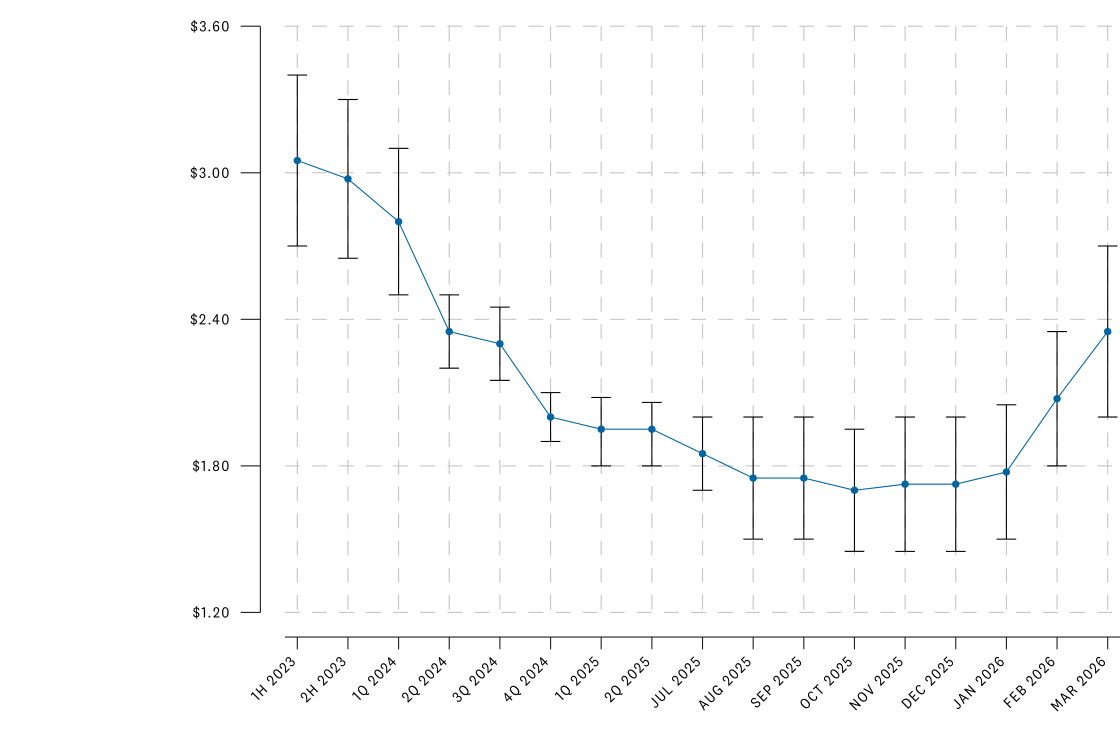
Figure 14
Rental prices of legacy chips over time. Between October 2025 and March 2026, one-year rental prices for an Nvidia H100, a four-year-old chip generation, increased by approximately 40%. Source: Semianalysis (2026).

Figure 14
Rental prices of legacy chips over time. Between October 2025 and March 2026, one-year rental prices for an Nvidia H100, a four-year-old chip generation, increased by approximately 40%. Source: Semianalysis (2026).
Compute will likely remain scarce for the foreseeable future. Chipmaking companies plan to invest over $100 billion in 2026 alone to expand the global supply of AI compute. Despite these efforts, several trends suggest that compute will remain a scarce resource over the coming years:
Compute will likely remain scarce for the foreseeable future. Chipmaking companies plan to invest over $100 billion in 2026 alone to expand the global supply of AI compute. Despite these efforts, several trends suggest that compute will remain a scarce resource over the coming years:
Compute demand for both training and inference will likely continue to grow rapidly. As described above, several proxies suggest that inference demand at a fixed model size and price is likely expanding ~10x per year, much faster than supply. Similarly, the compute required to develop a frontier model in the first place is also increasing exponentially, growing 4–5x per year. According to Epoch AI, this trend is likely to continue until 2030, meaning that by then a single frontier training run could draw 4–16 GW of power. Even the lower bound of this range exceeds the entire AI compute supply in Europe – including countries such as the UK and Norway – by the end of 2026 (~2 GW).
Cheaper inference appears to be tightening rather than relieving scarcity. Inference prices – the cost of serving a trained AI model to customers – are steeply declining for any given level of capability. For example, thanks to greater algorithmic and hardware efficiency, the cost of achieving GPT-4-level performance on PhD-level science questions had plummeted by 40x per year. These efficiency gains can relieve compute scarcity for routine, short-context workloads, where cheaper smaller models substitute for last year's frontier AI models. But at the frontier, demand so far appears to be growing faster than supply. Two factors play a role here. The first is a classic rebound effect: AI models are a general-purpose tool that can be used for a wide variety of purposes. As the tool becomes cheaper, people deploy it more widely. The second factor is that while AI capabilities at any given level become cheaper over time, AI companies are also releasing more capable – and usually more compute-intensive – models at a rapid pace. For example, the reasoning models at the heart of agentic AI systems like Claude Code have many more useful real-world applications than their predecessors, which leads to greater demand for these models despite the fact that they require more computational resources and are thus more expensive.
Supply chain bottlenecks are likely to remain persistent. Cutting-edge AI chips are the product of the world’s most complex supply chain, which is already running into severe technical and logistical limits to further scaling. For example, high-bandwidth memory – a key component of modern AI chips – is fully sold out for 2026, a bottleneck that industry and independent experts think could persist through 2027 and beyond. Similarly, TSMC’s 2-nanometer chip production process, required for the latest generation of AI chips, is reportedly sold out until 2028. From 2028 and beyond, some experts expect EUV machines to become the biggest bottleneck – chipmaking machines so complex that only one company in the world, the Dutch ASML, is able to produce them. This combination of supply chain constraints and rapidly increasing demand means that compute is unlikely to become an abundant commodity anytime soon.
Compute demand for both training and inference will likely continue to grow rapidly. As described above, several proxies suggest that inference demand at a fixed model size and price is likely expanding ~10x per year, much faster than supply. Similarly, the compute required to develop a frontier model in the first place is also increasing exponentially, growing 4–5x per year. According to Epoch AI, this trend is likely to continue until 2030, meaning that by then a single frontier training run could draw 4–16 GW of power. Even the lower bound of this range exceeds the entire AI compute supply in Europe – including countries such as the UK and Norway – by the end of 2026 (~2 GW).
Cheaper inference appears to be tightening rather than relieving scarcity. Inference prices – the cost of serving a trained AI model to customers – are steeply declining for any given level of capability. For example, thanks to greater algorithmic and hardware efficiency, the cost of achieving GPT-4-level performance on PhD-level science questions had plummeted by 40x per year. These efficiency gains can relieve compute scarcity for routine, short-context workloads, where cheaper smaller models substitute for last year's frontier AI models. But at the frontier, demand so far appears to be growing faster than supply. Two factors play a role here. The first is a classic rebound effect: AI models are a general-purpose tool that can be used for a wide variety of purposes. As the tool becomes cheaper, people deploy it more widely. The second factor is that while AI capabilities at any given level become cheaper over time, AI companies are also releasing more capable – and usually more compute-intensive – models at a rapid pace. For example, the reasoning models at the heart of agentic AI systems like Claude Code have many more useful real-world applications than their predecessors, which leads to greater demand for these models despite the fact that they require more computational resources and are thus more expensive.
Supply chain bottlenecks are likely to remain persistent. Cutting-edge AI chips are the product of the world’s most complex supply chain, which is already running into severe technical and logistical limits to further scaling. For example, high-bandwidth memory – a key component of modern AI chips – is fully sold out for 2026, a bottleneck that industry and independent experts think could persist through 2027 and beyond. Similarly, TSMC’s 2-nanometer chip production process, required for the latest generation of AI chips, is reportedly sold out until 2028. From 2028 and beyond, some experts expect EUV machines to become the biggest bottleneck – chipmaking machines so complex that only one company in the world, the Dutch ASML, is able to produce them. This combination of supply chain constraints and rapidly increasing demand means that compute is unlikely to become an abundant commodity anytime soon.
Given compute scarcity, universal access to frontier AI capability is not a given. In a world with transformative AI, this will turn into a decisive geopolitical factor: As AI becomes an essential driver of economic, political, and military power, compute access will directly determine a region’s place in the global distribution of power.
Without physical control, access to compute is precarious. Countries and regions whose AI workloads mostly run on foreign infrastructure – such as the EU, which only hosts around 5% of global AI compute – could be cut off from data centres and the frontier models that run on them at any time. This could happen for a variety of reasons, ranging from coercion over misuse concerns (e.g. terrorists using AI to design explosives) to the simple fact that, in a compute-scarce world, host countries might prioritise their own customers before supplying compute to the rest of the world.
Access restrictions around Anthropic’s Mythos illustrate this. Mythos is an AI model with strong offensive cyber capabilities and thus high misuse potential. Anthropic launched it in April 2026 through the tightly controlled Project Glasswing, initially restricting it to selected partners; no European actor was included. Only after sustained negotiations did Anthropic admit the EU cybersecurity agency ENISA. Less than two weeks later, the US government ordered Anthropic to suspend all access to Mythos and its consumer counterpart, Fable 5, for any foreign national, prompting Anthropic to disable both models worldwide. If the EU hosted a sizable fraction of physical AI infrastructure on its soil, including AI data centres used by US companies, it would be in a better position to negotiate frontier model access for EU companies and governments, ensuring that they are able to use state-of-the-art capabilities in areas such as cyberdefence and to stay economically competitive (see Objective 1.1 for a more detailed explanation of this ‘compute-for-access’ logic).
Within the EU, pooled infrastructure is a reasonable policy: Some countries are more natural homes for large data centres than others, including countries with cheap or reliable access to green energy, such as the Nordic countries, France, or Spain; or countries with decommissioned industrial sites that have existing, GW-scale grid connections, such as Germany. It makes sense to concentrate compute in these regions and distribute access fairly across the Union.
By contrast, dependence on non-European countries for compute supply is a risky bet, especially in the current geopolitical climate. The more critical a sector is for the functioning of Europe’s economy and public institutions, the more worrying such a dependence becomes. In sectors such as finance, energy, or healthcare, Member States need reliable access to compute, rather than relying merely on the trust and goodwill of foreign actors. The most straightforward way to achieve this is to ensure that a large fraction of European AI demand is served through data centres on EU soil, which are ultimately under European countries’ physical control.
Of an already scarce resource, the EU has very little. Researchers estimate that Europe as a whole – including non-EU countries such as the UK and Norway – will have around 2 GW of AI compute by the end of the year, constituting a roughly 5% share of 45 GW globally by that time.²⁶ This share is likely to stay roughly flat over the next five years if current trends continue, with approximately 21 GW of AI compute in Europe and ca. 370 GW globally in 2031. In the default scenario, and despite the AI Continent Action Plan’s stated goal to triple the EU’s data centre capacity over the next years, the EU’s share of global AI compute would therefore remain significantly below its 18% share of global GDP.
The EU should aim for a compute share in proportion to its share of the world economy. To fight its acute compute scarcity and control a meaningful share of the world’s AI infrastructure, EU Member States should collectively aim to host at least 15% of global AI compute by the end of the decade – roughly proportional to the EU’s 18% share of global GDP. In line with the compute forecast of the Europe 2031 scenario paper, this strategy assumes a global stock of AI compute of 300 GW by the end of 2030. This is roughly in line with estimates recently published by leading AI hardware forecasters, as Table 3 below shows.²⁷
Given compute scarcity, universal access to frontier AI capability is not a given. In a world with transformative AI, this will turn into a decisive geopolitical factor: As AI becomes an essential driver of economic, political, and military power, compute access will directly determine a region’s place in the global distribution of power.
Without physical control, access to compute is precarious. Countries and regions whose AI workloads mostly run on foreign infrastructure – such as the EU, which only hosts around 5% of global AI compute – could be cut off from data centres and the frontier models that run on them at any time. This could happen for a variety of reasons, ranging from coercion over misuse concerns (e.g. terrorists using AI to design explosives) to the simple fact that, in a compute-scarce world, host countries might prioritise their own customers before supplying compute to the rest of the world.
Access restrictions around Anthropic’s Mythos illustrate this. Mythos is an AI model with strong offensive cyber capabilities and thus high misuse potential. Anthropic launched it in April 2026 through the tightly controlled Project Glasswing, initially restricting it to selected partners; no European actor was included. Only after sustained negotiations did Anthropic admit the EU cybersecurity agency ENISA. Less than two weeks later, the US government ordered Anthropic to suspend all access to Mythos and its consumer counterpart, Fable 5, for any foreign national, prompting Anthropic to disable both models worldwide. If the EU hosted a sizable fraction of physical AI infrastructure on its soil, including AI data centres used by US companies, it would be in a better position to negotiate frontier model access for EU companies and governments, ensuring that they are able to use state-of-the-art capabilities in areas such as cyberdefence and to stay economically competitive (see Objective 1.1 for a more detailed explanation of this ‘compute-for-access’ logic).
Within the EU, pooled infrastructure is a reasonable policy: Some countries are more natural homes for large data centres than others, including countries with cheap or reliable access to green energy, such as the Nordic countries, France, or Spain; or countries with decommissioned industrial sites that have existing, GW-scale grid connections, such as Germany. It makes sense to concentrate compute in these regions and distribute access fairly across the Union.
By contrast, dependence on non-European countries for compute supply is a risky bet, especially in the current geopolitical climate. The more critical a sector is for the functioning of Europe’s economy and public institutions, the more worrying such a dependence becomes. In sectors such as finance, energy, or healthcare, Member States need reliable access to compute, rather than relying merely on the trust and goodwill of foreign actors. The most straightforward way to achieve this is to ensure that a large fraction of European AI demand is served through data centres on EU soil, which are ultimately under European countries’ physical control.
Of an already scarce resource, the EU has very little. Researchers estimate that Europe as a whole – including non-EU countries such as the UK and Norway – will have around 2 GW of AI compute by the end of the year, constituting a roughly 5% share of 45 GW globally by that time.²⁶ This share is likely to stay roughly flat over the next five years if current trends continue, with approximately 21 GW of AI compute in Europe and ca. 370 GW globally in 2031. In the default scenario, and despite the AI Continent Action Plan’s stated goal to triple the EU’s data centre capacity over the next years, the EU’s share of global AI compute would therefore remain significantly below its 18% share of global GDP.
The EU should aim for a compute share in proportion to its share of the world economy. To fight its acute compute scarcity and control a meaningful share of the world’s AI infrastructure, EU Member States should collectively aim to host at least 15% of global AI compute by the end of the decade – roughly proportional to the EU’s 18% share of global GDP. In line with the compute forecast of the Europe 2031 scenario paper, this strategy assumes a global stock of AI compute of 300 GW by the end of 2030. This is roughly in line with estimates recently published by leading AI hardware forecasters, as Table 3 below shows.²⁷
Source
Estimate of global AI compute
Time
Source
Estimate of global AI compute
Time
Table 3
A comparison of recent expert forecasts of global AI compute by the end of the decade.
Table 3
A comparison of recent expert forecasts of global AI compute by the end of the decade.
Our estimate of 300 GW of global AI compute (total facility power) by 2030 already prices in a slowdown of annual AI compute growth, mainly due to supply chain bottlenecks, from over 3x per year historically to around 1.25x per year by 2031. Similarly, it prices in that AI hardware will become more efficient over time. In a world where AI systems have transformative impact, however, greater hardware efficiency would likely have two main effects: (1) As a given level of AI capability becomes cheaper, customers will demand more of it. (2) AI companies can turn a given level of investment into greater AI capabilities. Both factors incentivise the AI industry to grow the global stock of AI compute far beyond current levels, even if the growth rate slows down over time. If AI compute growth slows down less than expected, a global supply >400 GW by 2030 is not inconceivable.
Assuming a total AI compute stock of 300 GW by 2030, a steady ramp up of compute in the EU could look like this:
Our estimate of 300 GW of global AI compute (total facility power) by 2030 already prices in a slowdown of annual AI compute growth, mainly due to supply chain bottlenecks, from over 3x per year historically to around 1.25x per year by 2031. Similarly, it prices in that AI hardware will become more efficient over time. In a world where AI systems have transformative impact, however, greater hardware efficiency would likely have two main effects: (1) As a given level of AI capability becomes cheaper, customers will demand more of it. (2) AI companies can turn a given level of investment into greater AI capabilities. Both factors incentivise the AI industry to grow the global stock of AI compute far beyond current levels, even if the growth rate slows down over time. If AI compute growth slows down less than expected, a global supply >400 GW by 2030 is not inconceivable.
Assuming a total AI compute stock of 300 GW by 2030, a steady ramp up of compute in the EU could look like this:
Year
EU AI compute
Global AI compute
EU share
Year
EU AI compute
Global AI compute
EU share
2026
1.8 GW
45 GW
4%
2026
1.8 GW
45 GW
4%
2027
4.9 GW
82 GW
6%
2027
4.9 GW
82 GW
6%
2028
12 GW
147 GW
8.2%
2028
12 GW
147 GW
8.2%
2029
24 GW
207 GW
11.6%
2029
24 GW
207 GW
11.6%
2030
45 GW
300 GW
15%
2030
45 GW
300 GW
15%
Table 4
A potential ramp-up of AI compute in the EU to reach the 15% target by 2030.
Table 4
A potential ramp-up of AI compute in the EU to reach the 15% target by 2030.
Reaching a goal of 45 GW by 2030 would require one of the most ambitious infrastructural programmes in the history of post-war Europe. Operating AI data centres with 45 GW capacity at full utilisation would increase the EU’s electricity consumption by 15.8% (394/2,492 TWh). A recent study found that this is feasible, subject to enough political will: In a “crisis mobilisation” scenario, the EU’s major power markets alone – France, Germany, Iberia, and the Nordics (ex-Norway) – could connect 35.6 GW of AI compute to their grids by 2030.³⁰ The remaining 9.4 GW could plausibly be provided by other EU countries, and potentially by relying on on-site power generation as a bridge solution while the European grid is being expanded.
The EU and its Member States should aim for this ambitious but feasible goal because transformative AI – understood here as AI systems that would materially affect the EU’s long-term role in the distribution of economic and geopolitical power – demands industrial-scale efforts that far exceed the pace of infrastructure expansion in normal times. The required effort could be reduced somewhat if the EU plans part of the compute expansion together with allied democracies such as Norway, Iceland, Canada, or Australia. Even in that case, a highly ambitious effort will still be required on EU soil. This will require difficult trade-offs and heavily rethinking established norms and procedures, but without it, EU countries are at the risk of losing their sovereignty and economic standing in a world where a region’s share of compute is a central determinant of its power and influence. The EU and its Member States should act quickly and with resolve to guard against this scenario, because the time to lock in geopolitical leverage through domestic compute on EU soil is now, rather than in the mid-2030s when AI companies could start to build data centres in space.
This strategy’s assessment is that, if the EU does not find creative ways to reach 15% of global AI compute by 2030, it will have much less leverage to secure access to frontier technology than in a world where it succeeds in this generational buildout. The situation is especially risky in light of a likely future compute crunch: The less physical leverage they have over computing infrastructure, the more Member States will have to fight for compute access by making potentially costly concessions elsewhere. Below, this deep dive outlines a difficult, but feasible, path towards realising an ambitious compute target. This strategy recommends this path not because it is politically easy to implement, but because Europe otherwise risks losing access to the strategic resource on which transformative AI depends.
Reaching a goal of 45 GW by 2030 would require one of the most ambitious infrastructural programmes in the history of post-war Europe. Operating AI data centres with 45 GW capacity at full utilisation would increase the EU’s electricity consumption by 15.8% (394/2,492 TWh). A recent study found that this is feasible, subject to enough political will: In a “crisis mobilisation” scenario, the EU’s major power markets alone – France, Germany, Iberia, and the Nordics (ex-Norway) – could connect 35.6 GW of AI compute to their grids by 2030.³⁰ The remaining 9.4 GW could plausibly be provided by other EU countries, and potentially by relying on on-site power generation as a bridge solution while the European grid is being expanded.
The EU and its Member States should aim for this ambitious but feasible goal because transformative AI – understood here as AI systems that would materially affect the EU’s long-term role in the distribution of economic and geopolitical power – demands industrial-scale efforts that far exceed the pace of infrastructure expansion in normal times. The required effort could be reduced somewhat if the EU plans part of the compute expansion together with allied democracies such as Norway, Iceland, Canada, or Australia. Even in that case, a highly ambitious effort will still be required on EU soil. This will require difficult trade-offs and heavily rethinking established norms and procedures, but without it, EU countries are at the risk of losing their sovereignty and economic standing in a world where a region’s share of compute is a central determinant of its power and influence. The EU and its Member States should act quickly and with resolve to guard against this scenario, because the time to lock in geopolitical leverage through domestic compute on EU soil is now, rather than in the mid-2030s when AI companies could start to build data centres in space.
This strategy’s assessment is that, if the EU does not find creative ways to reach 15% of global AI compute by 2030, it will have much less leverage to secure access to frontier technology than in a world where it succeeds in this generational buildout. The situation is especially risky in light of a likely future compute crunch: The less physical leverage they have over computing infrastructure, the more Member States will have to fight for compute access by making potentially costly concessions elsewhere. Below, this deep dive outlines a difficult, but feasible, path towards realising an ambitious compute target. This strategy recommends this path not because it is politically easy to implement, but because Europe otherwise risks losing access to the strategic resource on which transformative AI depends.
The EU and its Member States can achieve 45 GW of AI compute by 2030
The EU and its Member States can achieve 45 GW of AI compute by 2030
Who: The large majority of AI compute buildout in the EU should be done by the private sector. 45 GW of AI compute (total facility power) requires an enormous amount of investment. At an estimated capital expenditure of approximately $34 billion for a 1 GW AI data centre, the total cost of building these data centres would amount to approximately €1.3 trillion.³¹ Only the private sector is able to mobilise capital at this order-of-magnitude. Goldman Sachs estimates that $7.6 trillion will be spent on AI infrastructure over the next six years.³² This year, the US hyperscalers alone are on track to spend over $700 billion on capital expenditure, the majority of which is for AI data centres. Individual investors and consortia have similarly announced plans to channel large amounts of capital into AI infrastructure, for example the $500 billion Stargate Project, Saudi Arabia’s $100 billion Project Transcendence, and Brookfield’s $100 billion AI Infrastructure Program. The question is not whether this capital exists, but whether a significant fraction of it chooses the EU.
Moreover, Europe itself controls significant private capital that could be leveraged for large-scale AI compute. Asset managers in Europe as a whole oversee around €23 trillion of institutional capital;³³ redirecting capital equivalent to roughly 1.9% of this base annually over three years would be enough to finance the 45 GW ambition. That said, the majority of the buildout would have to be financed by US AI companies, as only the US hyperscalers and frontier developers currently generate enough demand to justify a double-digit GW buildout (that is, unless Europe attempted its own frontier project – see What would be required for a successful European frontier AI project?). As proposed above, US data centres on EU soil would serve as physical leverage to secure access to leading US models. This is why the alternative to 45 GW of AI compute majority-built by US companies is not 45 GW of European-only compute, but simply much less AI compute in Europe overall.
To further illustrate the scale, note that the proposed investment is less than what some other countries outside the US and China are spending on AI compute, relative to their size: For example, the Republic of Korea has announced private-led investment that is roughly 3x as much relative to its GDP.³⁴
While financing a 45 GW compute buildout should be mostly private sector-led, a public contribution from the EU and Member States of €100 billion to the €1.3 trillion overall investment would help to mobilise private funds and increase the share of European-only AI compute, owned and operated by European organisations on EU soil. These data centres could be used, for example, for sensitive workloads, public good use cases, or boosting European AI researchers and start-ups. For the most sensitive use cases, such as AI workloads in national security or defence, Member States should consider direct equity investment into AI data centres alongside private sector partners to ensure that the most critical AI infrastructure is publicly co-owned. Moreover, if the compute needs of a European developer of fast-follower models (see Objective 1.1) or emerging frontier company increased, it could readily tap into this European-only compute pool, rather than compete for scarce cloud compute with foreign frontier companies that locked in long-term contracts in advance. If, however, Europe owned more compute than domestic companies and researchers needed, it could rent out its compute to foreign customers at standard rates, which are likely to remain lucrative as compute remains scarce in a world with transformative AI. Raising €100 billion for AI compute through public funding is ambitious, but possible if different buckets are combined, with (for example) shares from the EU’s proposed Digital Leadership (€48.5 billion) and cohesion (€405 billion) budgets or the InvestEU Fund (€30 billion). A potential IPCEI for Frontier AI Compute would help to unlock corresponding amounts from Member States.
Where: Suitable sites for building large AI data centres quickly are limited, as a number of conditions all have to be in place: dozens or even hundreds of hectares of land, high-voltage grid connections (or options for on-site power generation), cooling infrastructure, fibre connections, and a favourable regulatory environment.
Most EU countries will have some sites that fulfil these conditions, and building 45 GW of compute will generally require a collective effort. However, some countries are much more favourable places for building data centres than others, for example, due to cheap or abundant green energy, a cold climate that eases cooling demands, or industrial brownfields with existing grid connections that can be repurposed for AI data centres. Therefore, there is a strong case for prioritising regions with the most favourable conditions, turning them into European compute centres whose benefits and burdens are shared across all EU countries. The table below offers a preliminary overview of what these regions could be:
Who: The large majority of AI compute buildout in the EU should be done by the private sector. 45 GW of AI compute (total facility power) requires an enormous amount of investment. At an estimated capital expenditure of approximately $34 billion for a 1 GW AI data centre, the total cost of building these data centres would amount to approximately €1.3 trillion.³¹ Only the private sector is able to mobilise capital at this order-of-magnitude. Goldman Sachs estimates that $7.6 trillion will be spent on AI infrastructure over the next six years.³² This year, the US hyperscalers alone are on track to spend over $700 billion on capital expenditure, the majority of which is for AI data centres. Individual investors and consortia have similarly announced plans to channel large amounts of capital into AI infrastructure, for example the $500 billion Stargate Project, Saudi Arabia’s $100 billion Project Transcendence, and Brookfield’s $100 billion AI Infrastructure Program. The question is not whether this capital exists, but whether a significant fraction of it chooses the EU.
Moreover, Europe itself controls significant private capital that could be leveraged for large-scale AI compute. Asset managers in Europe as a whole oversee around €23 trillion of institutional capital;³³ redirecting capital equivalent to roughly 1.9% of this base annually over three years would be enough to finance the 45 GW ambition. That said, the majority of the buildout would have to be financed by US AI companies, as only the US hyperscalers and frontier developers currently generate enough demand to justify a double-digit GW buildout (that is, unless Europe attempted its own frontier project – see What would be required for a successful European frontier AI project?). As proposed above, US data centres on EU soil would serve as physical leverage to secure access to leading US models. This is why the alternative to 45 GW of AI compute majority-built by US companies is not 45 GW of European-only compute, but simply much less AI compute in Europe overall.
To further illustrate the scale, note that the proposed investment is less than what some other countries outside the US and China are spending on AI compute, relative to their size: For example, the Republic of Korea has announced private-led investment that is roughly 3x as much relative to its GDP.³⁴
While financing a 45 GW compute buildout should be mostly private sector-led, a public contribution from the EU and Member States of €100 billion to the €1.3 trillion overall investment would help to mobilise private funds and increase the share of European-only AI compute, owned and operated by European organisations on EU soil. These data centres could be used, for example, for sensitive workloads, public good use cases, or boosting European AI researchers and start-ups. For the most sensitive use cases, such as AI workloads in national security or defence, Member States should consider direct equity investment into AI data centres alongside private sector partners to ensure that the most critical AI infrastructure is publicly co-owned. Moreover, if the compute needs of a European developer of fast-follower models (see Objective 1.1) or emerging frontier company increased, it could readily tap into this European-only compute pool, rather than compete for scarce cloud compute with foreign frontier companies that locked in long-term contracts in advance. If, however, Europe owned more compute than domestic companies and researchers needed, it could rent out its compute to foreign customers at standard rates, which are likely to remain lucrative as compute remains scarce in a world with transformative AI. Raising €100 billion for AI compute through public funding is ambitious, but possible if different buckets are combined, with (for example) shares from the EU’s proposed Digital Leadership (€48.5 billion) and cohesion (€405 billion) budgets or the InvestEU Fund (€30 billion). A potential IPCEI for Frontier AI Compute would help to unlock corresponding amounts from Member States.
Where: Suitable sites for building large AI data centres quickly are limited, as a number of conditions all have to be in place: dozens or even hundreds of hectares of land, high-voltage grid connections (or options for on-site power generation), cooling infrastructure, fibre connections, and a favourable regulatory environment.
Most EU countries will have some sites that fulfil these conditions, and building 45 GW of compute will generally require a collective effort. However, some countries are much more favourable places for building data centres than others, for example, due to cheap or abundant green energy, a cold climate that eases cooling demands, or industrial brownfields with existing grid connections that can be repurposed for AI data centres. Therefore, there is a strong case for prioritising regions with the most favourable conditions, turning them into European compute centres whose benefits and burdens are shared across all EU countries. The table below offers a preliminary overview of what these regions could be:
Country
Suitable regions (examples)
Advantages
Country
Suitable regions (examples)
Advantages
Denmark
Esbjerg (West), Varde, Ølgod
offshore wind surplus, cool climate
Denmark
Esbjerg (West), Varde, Ølgod
offshore wind surplus, cool climate
Finland
Lappeenranta, Mäntsälä, Kajaani, Myllykoski
abundant nuclear and hydropower, cool climate, strong tenant base
Finland
Lappeenranta, Mäntsälä, Kajaani, Myllykoski
abundant nuclear and hydropower, cool climate, strong tenant base
France
Hauts-de-France, Grand Est
nuclear surplus, industrial sites
France
Hauts-de-France, Grand Est
nuclear surplus, industrial sites
Germany
Rhineland, Lusatia, Northern Germany
industrial sites, high grid reliability, wind energy in the north
Germany
Rhineland, Lusatia, Northern Germany
industrial sites, high grid reliability, wind energy in the north
Poland
Silesia
industrial sites
Poland
Silesia
industrial sites
Portugal
Sines
planned GW-scale projects with sea water cooling, abundant solar/wind
Portugal
Sines
planned GW-scale projects with sea water cooling, abundant solar/wind
Romania
Cernavodă, Doicești
nuclear surplus, industrial sites
Romania
Cernavodă, Doicești
nuclear surplus, industrial sites
Spain
Aragón, Castilla-La Mancha
abundant solar/wind, experience through existing hyperscaler projects
Spain
Aragón, Castilla-La Mancha
abundant solar/wind, experience through existing hyperscaler projects
Sweden
Norrland, Falun, Strängnäs
abundant hydropower, cool climate
Sweden
Norrland, Falun, Strängnäs
abundant hydropower, cool climate
Table 5
Attractive AI data centre regions in the EU.
Table 5
Attractive AI data centre regions in the EU.
In order to leverage those assets, the EU should seek a mechanism whereby all countries contribute to ambitious data centre buildout in the most favourable regions and receive fair access to the resulting compute in return.
How: Only the private sector can realistically fund a compute buildout on the order of 45 GW, with public funding only playing a limited enabling role. Therefore, the role of the EU and its Member States lies mainly in two areas:
In order to leverage those assets, the EU should seek a mechanism whereby all countries contribute to ambitious data centre buildout in the most favourable regions and receive fair access to the resulting compute in return.
How: Only the private sector can realistically fund a compute buildout on the order of 45 GW, with public funding only playing a limited enabling role. Therefore, the role of the EU and its Member States lies mainly in two areas:
1.
Making the EU one of the world’s most attractive regions for private companies to build AI data centres.
2.
Securing the political success conditions for this buildout, both vis-à-vis (i) the US as the most powerful actor in the global chip supply chain and (ii) local communities and the broader population as the groups directly or indirectly affected by new data centres.
1.
Making the EU one of the world’s most attractive regions for private companies to build AI data centres.
2.
Securing the political success conditions for this buildout, both vis-à-vis (i) the US as the most powerful actor in the global chip supply chain and (ii) local communities and the broader population as the groups directly or indirectly affected by new data centres.
For concrete recommendations on how to achieve this, see Immediate Objective 3 in Part B of this strategy.
For concrete recommendations on how to achieve this, see Immediate Objective 3 in Part B of this strategy.
Robotics deep dive
Robotics deep dive
Robotics will likely become an important economic and strategic driver as AI becomes transformative, but Europe will play a leading role only if it substantially strengthens its position. Europe has historically been strong in manufacturing and deploying industrial robots, particularly precise, high-quality machines that performed narrow, repetitive tasks in heavily engineered environments. However, if current trends in AI continue, the value of manufacturing traditional industrial robots may decrease relative to the production of AI-integrated robots, which can adapt to changes, understand natural language, reason about unfamiliar tasks, and transfer what they learn across environments and robot embodiments. Europe retains deep hardware expertise and manufacturing capacity, but those advantages will not necessarily translate into leadership in this new paradigm: Europe lags in AI integration, does not have assured access to the frontier AI models underpinning the most advanced robotic systems, has limited manufacturing capacity in other embodiments, and is not well positioned to manufacture at scale. Remaining a leading robotics producer will therefore require Europe to reorient its robotics capacity toward AI-integrated systems rather than relying on traditional industrial robotics to provide an enduring edge.
A note on definitions
‘Frontier AI models’ refers to the most capable, general-purpose AI models, such as the models behind popular AI applications like Claude or ChatGPT. ‘AI-integrated robots’ refers to robotic systems that use models trained for functions such as perception, language understanding, planning, or control, and which generally enable greater adaptation to changes in tasks or environments. ‘Frontier robotics models’ refers to the most capable, relatively general-purpose models capable of operating a robot – systems that can accept natural-language instructions, reason about unfamiliar tasks, perform multi-step tasks, or transfer across environments and robot embodiments. Frontier robotics models can include advanced vision-language-action models specifically trained for robotic control, like Gemini Robotics 2. This can also include frontier AI models, which have demonstrated the ability to control robots in some tasks. Robots can take various shapes. ‘Form factor’ refers to the broad category of robot, including categories like fixed-base arms, autonomous mobile robots, mobile manipulators, humanoids, and drones, while ‘embodiment’ refers to the particular body or hardware on which a model operates (e.g., a specific company’s humanoid). This strategy uses ‘traditional industrial robots’ to principally refer to fixed-base industrial arms used in industrial settings.
Robotics will likely become an important economic and strategic driver as AI becomes transformative, but Europe will play a leading role only if it substantially strengthens its position. Europe has historically been strong in manufacturing and deploying industrial robots, particularly precise, high-quality machines that performed narrow, repetitive tasks in heavily engineered environments. However, if current trends in AI continue, the value of manufacturing traditional industrial robots may decrease relative to the production of AI-integrated robots, which can adapt to changes, understand natural language, reason about unfamiliar tasks, and transfer what they learn across environments and robot embodiments. Europe retains deep hardware expertise and manufacturing capacity, but those advantages will not necessarily translate into leadership in this new paradigm: Europe lags in AI integration, does not have assured access to the frontier AI models underpinning the most advanced robotic systems, has limited manufacturing capacity in other embodiments, and is not well positioned to manufacture at scale. Remaining a leading robotics producer will therefore require Europe to reorient its robotics capacity toward AI-integrated systems rather than relying on traditional industrial robotics to provide an enduring edge.
A note on definitions
‘Frontier AI models’ refers to the most capable, general-purpose AI models, such as the models behind popular AI applications like Claude or ChatGPT. ‘AI-integrated robots’ refers to robotic systems that use models trained for functions such as perception, language understanding, planning, or control, and which generally enable greater adaptation to changes in tasks or environments. ‘Frontier robotics models’ refers to the most capable, relatively general-purpose models capable of operating a robot – systems that can accept natural-language instructions, reason about unfamiliar tasks, perform multi-step tasks, or transfer across environments and robot embodiments. Frontier robotics models can include advanced vision-language-action models specifically trained for robotic control, like Gemini Robotics 2. This can also include frontier AI models, which have demonstrated the ability to control robots in some tasks. Robots can take various shapes. ‘Form factor’ refers to the broad category of robot, including categories like fixed-base arms, autonomous mobile robots, mobile manipulators, humanoids, and drones, while ‘embodiment’ refers to the particular body or hardware on which a model operates (e.g., a specific company’s humanoid). This strategy uses ‘traditional industrial robots’ to principally refer to fixed-base industrial arms used in industrial settings.
Europe has historically been strong in robotics
Europe has historically been strong in robotics
Historically, the robotics industry was built around precision and repeatability rather than adaptability. Industrial arms, which have been used in industrial processes like automotive manufacturing since the 1960s, were deployed before there was any form of “intelligent” operating system for robots. Instead, the movements of industrial arms were programmed to perform the same motions repeatedly. Because the sensing and corrective capacities of these robots were limited, both production lines and machines required precision: production lines were heavily engineered to ensure that products moving down a production line appeared before an industrial robot in the same position each time, and industrial robots were optimised for “repeatability” – the ability to perform the same motions over and over with as little variance as possible. Accordingly, the most competitive manufacturers of industrial robots were typically those who could produce robots with the greatest precision. Doing so requires high-quality hardware and specialised manufacturing processes – often themselves involving industrial robots. Advances in computer vision and motion-control software have made industrial robots better at following programmed trajectories accurately and making small corrections in response to variation. Even so, most remain limited to narrow, repeatable tasks.
Traditional industrial robots are costly to build and deploy, restricting their use primarily to highly standardised manufacturing. Because of the quality demands, industrial robots have typically been expensive investments. In addition to the cost of the robot itself, deploying traditional industrial robots has typically involved re-engineering production lines to operate with the precision required by industrial robots. Doing so is sufficiently capital-intensive that industrial robots were disproportionately deployed by large manufacturers, like automotive companies. The constraints of industrial robots – the lack of significant sensing or corrective capacity and the cost of deploying them – have meant that industrial robots are deployed in only a subset of industrial processes: industrial applications with high-throughput, low-variance production processes, especially in large manufacturers.
Europe and Japan dominate the traditional industrial robotics paradigm. Seventeen of the top 20 industrial robot manufacturers are Japanese or European, with seven headquartered in Europe (see Table 6). European robot manufacturers account for roughly one-third of estimated global industrial robot revenue. The industry is largely incumbent-dominated, with many of the largest companies having entered the robotics industry in the 1970s or 80s. For example, ABB (headquartered in Switzerland) and KUKA (headquartered in Germany but owned by China’s Midea Group), the two largest industrial robot manufacturers headquartered in Europe, both began manufacturing industrial robots in the early to mid 1970s. This is not to say that all European industrial robotics firms are this old – Universal Robots, for example, released its first robot in 2008 – but the majority of Europe’s robotics revenue is concentrated in incumbent firms. Europe is also a major deployer of industrial robots: Western Europe has a higher industrial robot density – a measure of industrial robot deployment relative to the number of manufacturing workers in a region – than North America or Asia.
Historically, the robotics industry was built around precision and repeatability rather than adaptability. Industrial arms, which have been used in industrial processes like automotive manufacturing since the 1960s, were deployed before there was any form of “intelligent” operating system for robots. Instead, the movements of industrial arms were programmed to perform the same motions repeatedly. Because the sensing and corrective capacities of these robots were limited, both production lines and machines required precision: production lines were heavily engineered to ensure that products moving down a production line appeared before an industrial robot in the same position each time, and industrial robots were optimised for “repeatability” – the ability to perform the same motions over and over with as little variance as possible. Accordingly, the most competitive manufacturers of industrial robots were typically those who could produce robots with the greatest precision. Doing so requires high-quality hardware and specialised manufacturing processes – often themselves involving industrial robots. Advances in computer vision and motion-control software have made industrial robots better at following programmed trajectories accurately and making small corrections in response to variation. Even so, most remain limited to narrow, repeatable tasks.
Traditional industrial robots are costly to build and deploy, restricting their use primarily to highly standardised manufacturing. Because of the quality demands, industrial robots have typically been expensive investments. In addition to the cost of the robot itself, deploying traditional industrial robots has typically involved re-engineering production lines to operate with the precision required by industrial robots. Doing so is sufficiently capital-intensive that industrial robots were disproportionately deployed by large manufacturers, like automotive companies. The constraints of industrial robots – the lack of significant sensing or corrective capacity and the cost of deploying them – have meant that industrial robots are deployed in only a subset of industrial processes: industrial applications with high-throughput, low-variance production processes, especially in large manufacturers.
Europe and Japan dominate the traditional industrial robotics paradigm. Seventeen of the top 20 industrial robot manufacturers are Japanese or European, with seven headquartered in Europe (see Table 6). European robot manufacturers account for roughly one-third of estimated global industrial robot revenue. The industry is largely incumbent-dominated, with many of the largest companies having entered the robotics industry in the 1970s or 80s. For example, ABB (headquartered in Switzerland) and KUKA (headquartered in Germany but owned by China’s Midea Group), the two largest industrial robot manufacturers headquartered in Europe, both began manufacturing industrial robots in the early to mid 1970s. This is not to say that all European industrial robotics firms are this old – Universal Robots, for example, released its first robot in 2008 – but the majority of Europe’s robotics revenue is concentrated in incumbent firms. Europe is also a major deployer of industrial robots: Western Europe has a higher industrial robot density – a measure of industrial robot deployment relative to the number of manufacturing workers in a region – than North America or Asia.
Rank
Company name
Country of manufacturing headquarters
Country of ownership
Robotics revenue (USD)
Revenue share
Cumulative revenue share
1
FANUC
Japan
Japan
$2,486M
16.7%
16.7%
2
ABB
Switzerland
Switzerland*
$2,331M
15.7%
32.5%
3
Yaskawa Electric (Motoman)
Japan
Japan
$1,622M
10.9%
43.4%
4
KUKA
Germany
China
$1,085M
7.3%
50.7%
5
Mitsubishi Electric (Factory Automation)
Japan
Japan
$873M
5.9%
56.6%
6
Kawasaki Heavy Industries (Robotics)
Japan
Japan
$610M
4.1%
60.7%
7
Stäubli Robotics
France
Switzerland
$515M
3.5%
64.2%
8
Brooks Automation
US
US
$372M
2.5%
66.7%
9
Durr
Germany
Germany
$360M
2.4%
69.1%
10
Universal Robots
Denmark
US
$308M
2.1%
71.2%
11
Rorze
Japan
Japan
$285M
1.9%
73.1%
12
Nidec
Japan
Japan
$263M
1.8%
74.9%
13
Estun Automation
China
China
$255M
1.7%
76.6%
14
OTC Daihen
Japan
Japan
$215M
1.4%
78.0%
15
Franka Emika / Agile Robots
Germany
Germany
$215M
1.4%
79.5%
16
HD Hyundai Robotics
South Korea
South Korea
$189M
1.3%
80.7%
17
Yamaha Motor (Robotics)
Japan
Japan
$183M
1.2%
82.0%
18
Nachi-Fujikoshi
Japan
Japan
$166M
1.1%
83.1%
19
Neura Robotics
Germany
Germany
$157M
1.1%
84.1%
20
Epson Robots
Japan
Japan
$154M
1.0%
85.2%
*SoftBank Group (Japan) has agreed to acquire ABB Robotics; closing is expected in the second half of 2026, subject to approvals.
*SoftBank Group (Japan) has agreed to acquire ABB Robotics; closing is expected in the second half of 2026, subject to approvals.
AI integration into robotics reduces Europe’s historical advantages in industrial robotics
AI integration into robotics reduces Europe’s historical advantages in industrial robotics
AI integration could have a transformative effect on robotics. AI integration into industrial robots has traditionally been limited. Some industrial robots are equipped with simple machine learning-based systems, like small computer vision models configured to recognise a defined set of objects. These are typically heavily tailored to the specific task. Frontier robotics models, by contrast, are large AI models–often referred to as vision-language-action models (VLAs)–trained on much larger and more heterogeneous datasets. For example, Physical Intelligence’s π₀ model was pretrained on 10,000 hours of dexterous-manipulation data spanning 68 tasks and seven robot configurations, in addition to large public datasets that pool more than one million robot trajectories. The training process for frontier robotics models is increasingly intensive as the models increase in size. OpenVLA – a seven-billion-parameter robot model trained on 970,000 real-world trajectories – required 64 NVIDIA A100 GPUs running for 15 days; Generalist AI’s models now exceed 10 billion parameters, and Generalist reports that its most recent model trained continuously for eight months. These robot-specific models often make use of existing large vision-language models (VLMs) for natural language, image processing, and reasoning ability. For example, Figure pairs a VLM with simulation and teleoperation data to train a robot able to process language commands and analyse scenes, and Gemini Robotics uses its Gemini AI models to enable robots to reason and problem-solve before passing off control for motor commands to a VLA. Additionally, preliminary evidence suggests that sufficiently advanced frontier AI models, like Claude, could be used for direct robotic control.
Transformative AI could dramatically accelerate robotics R&D. In addition to direct applications for robotic control, transformative AI could be used as a tool to speed up the development of robotics software and hardware. For example, frontier AI models could improve the success of simulation-based training, which is currently not sufficiently realistic to broadly enable successful transfer of simulation-trained skills to the real world without augmenting with real-world training data. Doing so would reduce the need for hard-to-scale real-world data, significantly accelerating progress in training advanced robotics models.
AI integration into robots could give robots new capabilities that enable them to succeed in a wider range of tasks. Many of the most advanced capabilities described below come from company demonstrations, and so should be treated as preliminary examples of advancing capabilities.
AI integration could have a transformative effect on robotics. AI integration into industrial robots has traditionally been limited. Some industrial robots are equipped with simple machine learning-based systems, like small computer vision models configured to recognise a defined set of objects. These are typically heavily tailored to the specific task. Frontier robotics models, by contrast, are large AI models–often referred to as vision-language-action models (VLAs)–trained on much larger and more heterogeneous datasets. For example, Physical Intelligence’s π₀ model was pretrained on 10,000 hours of dexterous-manipulation data spanning 68 tasks and seven robot configurations, in addition to large public datasets that pool more than one million robot trajectories. The training process for frontier robotics models is increasingly intensive as the models increase in size. OpenVLA – a seven-billion-parameter robot model trained on 970,000 real-world trajectories – required 64 NVIDIA A100 GPUs running for 15 days; Generalist AI’s models now exceed 10 billion parameters, and Generalist reports that its most recent model trained continuously for eight months. These robot-specific models often make use of existing large vision-language models (VLMs) for natural language, image processing, and reasoning ability. For example, Figure pairs a VLM with simulation and teleoperation data to train a robot able to process language commands and analyse scenes, and Gemini Robotics uses its Gemini AI models to enable robots to reason and problem-solve before passing off control for motor commands to a VLA. Additionally, preliminary evidence suggests that sufficiently advanced frontier AI models, like Claude, could be used for direct robotic control.
Transformative AI could dramatically accelerate robotics R&D. In addition to direct applications for robotic control, transformative AI could be used as a tool to speed up the development of robotics software and hardware. For example, frontier AI models could improve the success of simulation-based training, which is currently not sufficiently realistic to broadly enable successful transfer of simulation-trained skills to the real world without augmenting with real-world training data. Doing so would reduce the need for hard-to-scale real-world data, significantly accelerating progress in training advanced robotics models.
AI integration into robots could give robots new capabilities that enable them to succeed in a wider range of tasks. Many of the most advanced capabilities described below come from company demonstrations, and so should be treated as preliminary examples of advancing capabilities.
Flexibility. AI enables robots to adapt to changes in a task, without requiring production processes to be standardised and invariable. For example, an AI-integrated robot using vision to pick up objects can navigate to them even as they move and appear in different positions, rather than assuming specific coordinates, and figure out how to grasp objects of different shapes. Simple versions of these already exist in industrial robots. For example, ABB’s Robotic Item Picker system uses a suction gripper to pick up stationary objects of different sizes and shapes. Frontier robotic models go further, demonstrating the ability to fold clothes they have never seen before, do task sequences they were not trained on based just on verbal instructions, and adapt to new tools and environments. Frontier models are also able to transfer skills learned in one embodiment to a different embodiment (for example, one with longer arms or different hands) – this cross-embodiment transfer enables deployment in a wider range of embodiments without requiring further training. This enables the deployment of robots in cases where they would previously have been uneconomical, including low-volume or high-variance production processes.
Hard-to-program manipulation. Some motions are difficult to reduce to a fixed trajectory because the object changes shape or moves unpredictably. Tasks involving these motions, including manipulating fabric, routing wire harnesses, and handling food, have historically been difficult to automate with industrial robots. Frontier demonstrations now include folding clothing, handling fruit, doing origami and other deformable-object tasks.
Lower dependence on mechanical precision. Improved perception and correction reduce the required mechanical repeatability in certain contexts. For example, if a robotic arm with embodied intelligence can repeatedly evaluate and replan its trajectory, it does not need to be as mechanically precise in its movements. This does not make hardware quality obsolete – it would be difficult for intelligence to substitute for core features like payload tolerance – but it may reduce the relative value of mechanical precision.
Ease of deployment. Flexible robots reduce the need for reorganising a production line to ensure the robot sees low variance processes. Instead, more intelligent robots could handle higher variance processes without having to reconfigure the production processes. For example, frontier demonstrations show robots sorting packages of varying sizes, shapes, and placements in a warehouse, and successfully placing items in their intended containers even as the containers move around. Additionally, more intelligent robots are easier to teach new tasks: frontier robotics models are able to learn to do a task from in-context information (i.e., without having to update their model weights), and can do so from a single example, even just watching a human do a task (see, for example, Generalist AI or Skild AI).
Reasoning and intelligence. Many physical tasks are difficult to reduce to pre-planned motions because they require understanding a goal, planning subtasks, adapting to changing conditions, solving problems, or language- or vision-based judgement. Sufficient intelligence enables robots to complete more complex tasks than they would have otherwise. Frontier robotics models exhibit some reasoning abilities, like stringing together multiple subtasks to perform long-horizon tasks, understanding and acting on natural language commands, and even searching the internet for context. Further advances, including greater integration of frontier AI models into robot control systems, could increase the complexity of automatable tasks. For example, sufficient intelligence would enable tasks like reading and understanding a natural-language assembly manual, doing construction work in new terrain, repairing machinery with unknown problems, exploring novel environments, and communicating with other robots or humans to complete a complex task.
Flexibility. AI enables robots to adapt to changes in a task, without requiring production processes to be standardised and invariable. For example, an AI-integrated robot using vision to pick up objects can navigate to them even as they move and appear in different positions, rather than assuming specific coordinates, and figure out how to grasp objects of different shapes. Simple versions of these already exist in industrial robots. For example, ABB’s Robotic Item Picker system uses a suction gripper to pick up stationary objects of different sizes and shapes. Frontier robotic models go further, demonstrating the ability to fold clothes they have never seen before, do task sequences they were not trained on based just on verbal instructions, and adapt to new tools and environments. Frontier models are also able to transfer skills learned in one embodiment to a different embodiment (for example, one with longer arms or different hands) – this cross-embodiment transfer enables deployment in a wider range of embodiments without requiring further training. This enables the deployment of robots in cases where they would previously have been uneconomical, including low-volume or high-variance production processes.
Hard-to-program manipulation. Some motions are difficult to reduce to a fixed trajectory because the object changes shape or moves unpredictably. Tasks involving these motions, including manipulating fabric, routing wire harnesses, and handling food, have historically been difficult to automate with industrial robots. Frontier demonstrations now include folding clothing, handling fruit, doing origami and other deformable-object tasks.
Lower dependence on mechanical precision. Improved perception and correction reduce the required mechanical repeatability in certain contexts. For example, if a robotic arm with embodied intelligence can repeatedly evaluate and replan its trajectory, it does not need to be as mechanically precise in its movements. This does not make hardware quality obsolete – it would be difficult for intelligence to substitute for core features like payload tolerance – but it may reduce the relative value of mechanical precision.
Ease of deployment. Flexible robots reduce the need for reorganising a production line to ensure the robot sees low variance processes. Instead, more intelligent robots could handle higher variance processes without having to reconfigure the production processes. For example, frontier demonstrations show robots sorting packages of varying sizes, shapes, and placements in a warehouse, and successfully placing items in their intended containers even as the containers move around. Additionally, more intelligent robots are easier to teach new tasks: frontier robotics models are able to learn to do a task from in-context information (i.e., without having to update their model weights), and can do so from a single example, even just watching a human do a task (see, for example, Generalist AI or Skild AI).
Reasoning and intelligence. Many physical tasks are difficult to reduce to pre-planned motions because they require understanding a goal, planning subtasks, adapting to changing conditions, solving problems, or language- or vision-based judgement. Sufficient intelligence enables robots to complete more complex tasks than they would have otherwise. Frontier robotics models exhibit some reasoning abilities, like stringing together multiple subtasks to perform long-horizon tasks, understanding and acting on natural language commands, and even searching the internet for context. Further advances, including greater integration of frontier AI models into robot control systems, could increase the complexity of automatable tasks. For example, sufficient intelligence would enable tasks like reading and understanding a natural-language assembly manual, doing construction work in new terrain, repairing machinery with unknown problems, exploring novel environments, and communicating with other robots or humans to complete a complex task.
The above capabilities could allow robots to perform many more tasks across the economy. If AI becomes transformative, it is possible that sufficiently capable systems will eventually automate most, if not all, physical work now performed by humans. The potential economic value of developing frontier robots could therefore be very large.
The above capabilities could allow robots to perform many more tasks across the economy. If AI becomes transformative, it is possible that sufficiently capable systems will eventually automate most, if not all, physical work now performed by humans. The potential economic value of developing frontier robots could therefore be very large.
European leadership in robotics is far from guaranteed
European leadership in robotics is far from guaranteed
There are several reasons why Europe’s historical strengths in industrial robotics may not translate into comparable gains in an AI-driven robotics paradigm:
European robotics manufacturers are mostly not building custom AI-integrated robots. European industrial-robot incumbents use AI mainly for narrow applications. For example, ABB’s Robotic Item Picker, as discussed above, applies AI-based vision for defined pick-and-place problems. Certain European companies are partnering with non-European companies to allow their robots advanced AI integration: for example, ABB is integrating NVIDIA simulation and foundation-model tools into its platform to allow users to incorporate more advanced AI systems, and Universal Robots’ AI Accelerator incorporates NVIDIA hardware and software into its robots for developer use. These efforts may make existing products more capable. But there appear to be few, if any, major European industrial-robot incumbents that are developing a proprietary, general-purpose robot model able to follow natural-language instructions and operate across varied tasks, environments, and embodiments. The leading incumbents are therefore positioned mainly as hardware and integration providers, rather than developers of core models. While new European robotics companies have emerged in recent years that are oriented towards frontier AI integration, such as Agile Robots or Neura Robotics, the ecosystem remains small and few European companies have publicly demonstrated robots that use frontier AI models for perception, planning, or control (and fewer still are developing the underlying models themselves). Additionally, established manufacturers like ABB and KUKA are mostly not developing frontier VLAs. Europe’s frontier-robotics sector is therefore emerging for the most part outside the incumbents that underpin its existing robotics strength. These startups are also much smaller and less well capitalised than leading US competitors, reflecting Europe’s broader difficulty in financing and scaling new technology companies (see Objective 2.1).
Europe's hardware lead is concentrated in traditional industrial robots. Europe is most dominant in fixed-base industrial robots. While industrial robots will almost certainly continue to be an important form factor, they are only one of many poised to benefit from AI integration into robotics, which also include autonomous mobile robots, mobile manipulators, humanoids, drones, among others. Europe’s manufacturing presence in these other sectors is smaller: European shipments accounted for about 11% of autonomous mobile robots for intralogistics in 2024, and a negligible share of humanoids in 2025. While the hardware supply chains and manufacturing capacity of industrial arms are well-suited for some level of transfer to other form factors, Europe is not, by default, poised to manufacture most of the form factors that could benefit from the returns to AI integration.
Europe’s continued dominance in traditional industrial robotics is also not a given. While traditional industrial robots will likely remain valuable, China is rapidly encroaching on incumbent market share. China’s share of global industrial robot production has increased from 9% in 2016 to over 30% in 2024, and China has significantly reduced its import reliance for industrial robots. China has also made significant inroads as an upstream hardware supplier. For example, Chinese manufacturer Leaderdrive began producing an increasingly large share of Universal Robots’ strainwave reducers in the late 2010s, accounting for around 30% of Universal Robots’ reducers in 2019 (though recent figures are unclear). Additionally, several European-headquartered industrial robotics companies have lost European ownership: KUKA is owned by China’s Midea, Universal Robots by US-based Teradyne, and ABB has agreed to sell its robotics division to Japan’s SoftBank. Traditional industrial robotics is not a guaranteed fallback if Europe fails to lead in AI-enabled robotics.
Europe's dominance in high-precision, high-quality hardware might be less important than the ability to manufacture at scale. As the scope of tasks that robotic systems are able to automate broadens beyond narrow, high-precision industrial tasks, the ability to swiftly increase production may matter more than the ability to manufacture exceptionally high-quality robots – where Europe’s dominance has historically been. While Europe remains strong in the final assembly of traditional robots, it is more reliant on foreign suppliers for raw and processed materials than China is. More broadly, China produced 35% of global manufacturing output, compared with 13% for the euro area, and more than the next ten largest manufacturing countries combined. China’s manufacturing base has also expanded considerably faster: in the first quarter of 2026, its output was 39% above its 2020 level and 5.6% higher than a year earlier, while European output was 12% above its 2020 level and 1.2% lower than a year earlier. In practice, China’s dense hardware ecosystems and broader manufacturing capacity appear to enable Chinese robotics companies to develop and manufacture robots faster and more cheaply.
Europe lags in frontier models. Some leading robotics companies, such as Physical Intelligence in the US, focus on developing frontier robotics models rather than building their own embodiments. Physical Intelligence, along with other leading robot-model companies such as NVIDIA, Figure AI and Skild AI, are mostly American. While Europe does have a few developers, such as Agile Robots, building robotics foundation models, no European company has emerged as a clear peer to the leading US companies in the demonstrated generality and capabilities of its models. Europe also lags behind on general-purpose AI models, which increasingly provide robots with perception, language understanding and reasoning. The 2026 Stanford AI Index attributes 59 notable AI models released in 2025 to the United States, 35 to China and two to Europe. Even if a different architecture replaced LLMs as the main paradigm behind general-purpose models in the future, this would not necessarily favour Europe: While it could create opportunities for new entrants, developing successful robotics models under any paradigm would still require frontier AI talent, compute, data, and capital. These resources are currently concentrated in foreign AI companies, and a greater share would end up in Europe only through an ambitious attempt to attract them.
Europe lacks reliable access to frontier models built elsewhere. While European companies could use open-source models, the most capable frontier models are closed-source, including an increasing share of frontier robotics models. For example, many frontier robotics model developers like Figure, 1X Technologies, Generalist AI, and Skild AI do not release their models. Access to frontier models from foreign developers is not guaranteed (see Objective 1.1). Ongoing access to open-source models is not guaranteed, either; for example, Physical Intelligence – a frontier research lab which open-sourced its first generations of models – has not released its two most recent models. As robots take on increasingly complex tasks, differences in reasoning and planning ability will increasingly determine what they can do reliably and how economical they are to deploy; if European robotics companies must rely on less capable general-purpose AI or robotics models, they could become less competitive than companies with access to frontier models. Gaps in access to the best models could also compound over time: Frontier general-purpose AI models could accelerate robotics R&D (e.g., through improved sim-to-real transfer), while frontier robotics models could enable more capable deployments, generating real-world interaction data that can be used to improve subsequent models.
Europe’s industrial data will not necessarily provide strong advantages in frontier robotics. European factories generate extensive production telemetry, quality records and maintenance data. In an effort to take advantage of the data generated by Europe’s industrial base, the EU has launched several initiatives to facilitate the sharing of manufacturing data, including data generated by industrial robots and other machinery. Training frontier robotics models, however, often needs synchronised camera or tactile observations, robot states, actions, task labels and outcomes. Legacy arms were not necessarily designed to record or share all that data. For example, many industrial arms do not collect synchronised video and joint-level motion data. Data is also more valuable for training if it has greater variance, leading frontier robotics labs like Figure to create custom data collection platforms to build more diverse training sets. By contrast, industrial robots often collect data from repetitive motions in environments with little variation, like industrial production lines. Additionally, to be deployed, robots usually must have very high success rates in their tasks, making it difficult to use their data to train on the difference between successful and unsuccessful operation. While data collected from deployed robots may still be valuable, the high repetition from industrial robots and the low failure rate may limit the usefulness of the data for training generalised physical skills.
There are several reasons why Europe’s historical strengths in industrial robotics may not translate into comparable gains in an AI-driven robotics paradigm:
European robotics manufacturers are mostly not building custom AI-integrated robots. European industrial-robot incumbents use AI mainly for narrow applications. For example, ABB’s Robotic Item Picker, as discussed above, applies AI-based vision for defined pick-and-place problems. Certain European companies are partnering with non-European companies to allow their robots advanced AI integration: for example, ABB is integrating NVIDIA simulation and foundation-model tools into its platform to allow users to incorporate more advanced AI systems, and Universal Robots’ AI Accelerator incorporates NVIDIA hardware and software into its robots for developer use. These efforts may make existing products more capable. But there appear to be few, if any, major European industrial-robot incumbents that are developing a proprietary, general-purpose robot model able to follow natural-language instructions and operate across varied tasks, environments, and embodiments. The leading incumbents are therefore positioned mainly as hardware and integration providers, rather than developers of core models. While new European robotics companies have emerged in recent years that are oriented towards frontier AI integration, such as Agile Robots or Neura Robotics, the ecosystem remains small and few European companies have publicly demonstrated robots that use frontier AI models for perception, planning, or control (and fewer still are developing the underlying models themselves). Additionally, established manufacturers like ABB and KUKA are mostly not developing frontier VLAs. Europe’s frontier-robotics sector is therefore emerging for the most part outside the incumbents that underpin its existing robotics strength. These startups are also much smaller and less well capitalised than leading US competitors, reflecting Europe’s broader difficulty in financing and scaling new technology companies (see Objective 2.1).
Europe's hardware lead is concentrated in traditional industrial robots. Europe is most dominant in fixed-base industrial robots. While industrial robots will almost certainly continue to be an important form factor, they are only one of many poised to benefit from AI integration into robotics, which also include autonomous mobile robots, mobile manipulators, humanoids, drones, among others. Europe’s manufacturing presence in these other sectors is smaller: European shipments accounted for about 11% of autonomous mobile robots for intralogistics in 2024, and a negligible share of humanoids in 2025. While the hardware supply chains and manufacturing capacity of industrial arms are well-suited for some level of transfer to other form factors, Europe is not, by default, poised to manufacture most of the form factors that could benefit from the returns to AI integration.
Europe’s continued dominance in traditional industrial robotics is also not a given. While traditional industrial robots will likely remain valuable, China is rapidly encroaching on incumbent market share. China’s share of global industrial robot production has increased from 9% in 2016 to over 30% in 2024, and China has significantly reduced its import reliance for industrial robots. China has also made significant inroads as an upstream hardware supplier. For example, Chinese manufacturer Leaderdrive began producing an increasingly large share of Universal Robots’ strainwave reducers in the late 2010s, accounting for around 30% of Universal Robots’ reducers in 2019 (though recent figures are unclear). Additionally, several European-headquartered industrial robotics companies have lost European ownership: KUKA is owned by China’s Midea, Universal Robots by US-based Teradyne, and ABB has agreed to sell its robotics division to Japan’s SoftBank. Traditional industrial robotics is not a guaranteed fallback if Europe fails to lead in AI-enabled robotics.
Europe's dominance in high-precision, high-quality hardware might be less important than the ability to manufacture at scale. As the scope of tasks that robotic systems are able to automate broadens beyond narrow, high-precision industrial tasks, the ability to swiftly increase production may matter more than the ability to manufacture exceptionally high-quality robots – where Europe’s dominance has historically been. While Europe remains strong in the final assembly of traditional robots, it is more reliant on foreign suppliers for raw and processed materials than China is. More broadly, China produced 35% of global manufacturing output, compared with 13% for the euro area, and more than the next ten largest manufacturing countries combined. China’s manufacturing base has also expanded considerably faster: in the first quarter of 2026, its output was 39% above its 2020 level and 5.6% higher than a year earlier, while European output was 12% above its 2020 level and 1.2% lower than a year earlier. In practice, China’s dense hardware ecosystems and broader manufacturing capacity appear to enable Chinese robotics companies to develop and manufacture robots faster and more cheaply.
Europe lags in frontier models. Some leading robotics companies, such as Physical Intelligence in the US, focus on developing frontier robotics models rather than building their own embodiments. Physical Intelligence, along with other leading robot-model companies such as NVIDIA, Figure AI and Skild AI, are mostly American. While Europe does have a few developers, such as Agile Robots, building robotics foundation models, no European company has emerged as a clear peer to the leading US companies in the demonstrated generality and capabilities of its models. Europe also lags behind on general-purpose AI models, which increasingly provide robots with perception, language understanding and reasoning. The 2026 Stanford AI Index attributes 59 notable AI models released in 2025 to the United States, 35 to China and two to Europe. Even if a different architecture replaced LLMs as the main paradigm behind general-purpose models in the future, this would not necessarily favour Europe: While it could create opportunities for new entrants, developing successful robotics models under any paradigm would still require frontier AI talent, compute, data, and capital. These resources are currently concentrated in foreign AI companies, and a greater share would end up in Europe only through an ambitious attempt to attract them.
Europe lacks reliable access to frontier models built elsewhere. While European companies could use open-source models, the most capable frontier models are closed-source, including an increasing share of frontier robotics models. For example, many frontier robotics model developers like Figure, 1X Technologies, Generalist AI, and Skild AI do not release their models. Access to frontier models from foreign developers is not guaranteed (see Objective 1.1). Ongoing access to open-source models is not guaranteed, either; for example, Physical Intelligence – a frontier research lab which open-sourced its first generations of models – has not released its two most recent models. As robots take on increasingly complex tasks, differences in reasoning and planning ability will increasingly determine what they can do reliably and how economical they are to deploy; if European robotics companies must rely on less capable general-purpose AI or robotics models, they could become less competitive than companies with access to frontier models. Gaps in access to the best models could also compound over time: Frontier general-purpose AI models could accelerate robotics R&D (e.g., through improved sim-to-real transfer), while frontier robotics models could enable more capable deployments, generating real-world interaction data that can be used to improve subsequent models.
Europe’s industrial data will not necessarily provide strong advantages in frontier robotics. European factories generate extensive production telemetry, quality records and maintenance data. In an effort to take advantage of the data generated by Europe’s industrial base, the EU has launched several initiatives to facilitate the sharing of manufacturing data, including data generated by industrial robots and other machinery. Training frontier robotics models, however, often needs synchronised camera or tactile observations, robot states, actions, task labels and outcomes. Legacy arms were not necessarily designed to record or share all that data. For example, many industrial arms do not collect synchronised video and joint-level motion data. Data is also more valuable for training if it has greater variance, leading frontier robotics labs like Figure to create custom data collection platforms to build more diverse training sets. By contrast, industrial robots often collect data from repetitive motions in environments with little variation, like industrial production lines. Additionally, to be deployed, robots usually must have very high success rates in their tasks, making it difficult to use their data to train on the difference between successful and unsuccessful operation. While data collected from deployed robots may still be valuable, the high repetition from industrial robots and the low failure rate may limit the usefulness of the data for training generalised physical skills.
Going forward: adapting Europe’s robotics capacity
Going forward: adapting Europe’s robotics capacity
Europe is not starting from zero. European companies remain globally competitive in industrial robotics, with significant hardware production capacity and deep expertise in high-quality industrial robot manufacturing processes. Additionally, industrial robotics capacity is, to some extent, general purpose, with many areas of hardware and manufacturing overlapping. For example, humanoids, like industrial robots, need joint-level actuators and operable end-effectors, and mobile robots use similar types of motors to industrial arms. Under any future, robots will require reliable embodiments, and Europe has many of the supply chains and production processes to make the relevant components. If Europe were to reorient towards the frontier of robotics – AI integration into varied autonomous form factors – it has deep resources on which to draw. Doing so could give Europe a shot at retaining its strength in robotics.
Europe should use its industries as a testbed for further industrial automation. Western Europe already has a more automated industrial sector (as measured by the ratio of industrial robots to manufacturing workers) than Asia or North America. This gives Europe a dense and diverse base of factories and production processes that can serve as testing grounds for early robotics deployment. The EU and Member States could co-fund production pilots that pair European robotics and AI developers with manufacturers and support the deployment of advanced robotic systems. Operating in real factories would give European robotics companies access to diverse task and failure data, and allow them to demonstrate their aptitude for greater commercialisation.
Data-sharing efforts should focus on the most valuable sources of data for robotics. As discussed above, Europe’s large industrial base may not automatically produce a data advantage: its data is often narrow and repetitive and may not include the necessary task annotations. Developing advanced robotics models, by contrast, requires data that capture varied tasks, environments and outcomes, which might involve specialised data collection (e.g., collection that explicitly labels whether a robot was successful in a task). European robotics initiatives should therefore prioritise creating systems to share the types of data that are most valuable for advanced model development, while protecting commercially sensitive information.
Europe should fund robotics R&D and commercialisation. Robotics is a capital-intensive industry, and Europe’s broader difficulties in financing and scaling new technology companies (see Objective 2.1) will impede Europe’s success in frontier robotics. The EU and Member States should consider expanding funding for frontier robotics research and commercialisation efforts. This could include support for research groups and startups, as well as incumbent robotics companies or hardware manufacturers attempting to transition into frontier robotics. Prioritising robotics companies’ access to compute could also be a useful lever for accelerating European development of frontier robotics models.
Europe could benefit from well-designed partnerships with foreign companies. European robot manufacturers are unlikely to develop their own frontier models in the near term, so partnerships with foreign model developers could accelerate the integration of advanced AI into European hardware. Such partnerships should be designed in a way that protects European intellectual property, for example by using privacy-enhancing technologies when sharing sensitive proprietary data.
Standardised regulations should facilitate robot deployments across the EU. Differing regulatory standards by jurisdiction could slow down real-world testing and deployment of advanced robotic systems. The Commission should ensure that regulations guiding the production and deployment of advanced robots – including those, like humanoids, with high levels of autonomy – are clear and harmonised across the EU.
Europe is not starting from zero. European companies remain globally competitive in industrial robotics, with significant hardware production capacity and deep expertise in high-quality industrial robot manufacturing processes. Additionally, industrial robotics capacity is, to some extent, general purpose, with many areas of hardware and manufacturing overlapping. For example, humanoids, like industrial robots, need joint-level actuators and operable end-effectors, and mobile robots use similar types of motors to industrial arms. Under any future, robots will require reliable embodiments, and Europe has many of the supply chains and production processes to make the relevant components. If Europe were to reorient towards the frontier of robotics – AI integration into varied autonomous form factors – it has deep resources on which to draw. Doing so could give Europe a shot at retaining its strength in robotics.
Europe should use its industries as a testbed for further industrial automation. Western Europe already has a more automated industrial sector (as measured by the ratio of industrial robots to manufacturing workers) than Asia or North America. This gives Europe a dense and diverse base of factories and production processes that can serve as testing grounds for early robotics deployment. The EU and Member States could co-fund production pilots that pair European robotics and AI developers with manufacturers and support the deployment of advanced robotic systems. Operating in real factories would give European robotics companies access to diverse task and failure data, and allow them to demonstrate their aptitude for greater commercialisation.
Data-sharing efforts should focus on the most valuable sources of data for robotics. As discussed above, Europe’s large industrial base may not automatically produce a data advantage: its data is often narrow and repetitive and may not include the necessary task annotations. Developing advanced robotics models, by contrast, requires data that capture varied tasks, environments and outcomes, which might involve specialised data collection (e.g., collection that explicitly labels whether a robot was successful in a task). European robotics initiatives should therefore prioritise creating systems to share the types of data that are most valuable for advanced model development, while protecting commercially sensitive information.
Europe should fund robotics R&D and commercialisation. Robotics is a capital-intensive industry, and Europe’s broader difficulties in financing and scaling new technology companies (see Objective 2.1) will impede Europe’s success in frontier robotics. The EU and Member States should consider expanding funding for frontier robotics research and commercialisation efforts. This could include support for research groups and startups, as well as incumbent robotics companies or hardware manufacturers attempting to transition into frontier robotics. Prioritising robotics companies’ access to compute could also be a useful lever for accelerating European development of frontier robotics models.
Europe could benefit from well-designed partnerships with foreign companies. European robot manufacturers are unlikely to develop their own frontier models in the near term, so partnerships with foreign model developers could accelerate the integration of advanced AI into European hardware. Such partnerships should be designed in a way that protects European intellectual property, for example by using privacy-enhancing technologies when sharing sensitive proprietary data.
Standardised regulations should facilitate robot deployments across the EU. Differing regulatory standards by jurisdiction could slow down real-world testing and deployment of advanced robotic systems. The Commission should ensure that regulations guiding the production and deployment of advanced robots – including those, like humanoids, with high levels of autonomy – are clear and harmonised across the EU.
Footnotes
All GW estimates of European and global AI compute in this deep dive refer to total facility power.
All GW estimates of European and global AI compute in this deep dive refer to total facility power.
Some AI experts have put forward more aggressive estimates, such as Leopold Aschenbrenner in his article ‘Situational Awareness’. His back-of-the-envelope calculation projects that by 2030, the world’s AI data centre capacity will be equivalent to total US power generation – around 4,250 TWh according to Aschenbrenner, likely referring to 2023, equivalent to an average load of 485 GW. Apart from AI forecasting experts, consultancies have also estimated AI compute growth, with McKinsey expecting 90 GW by 2030 and Goldman Sachs 24 GW by 2030 (as presented by RAND). The 24 GW estimate by Goldman has likely been overtaken by reality already, with Epoch AI estimating approximately 30 GW of AI compute at the end of 2025. As RAND notes, conservative estimates from Goldman and McKinsey only assume a ‘brief period of exponential growth’ in AI. This is contrary to the premises of this strategy, which assumes that AI capabilities and the required inputs will continue to grow until AI has transformative effects.
Some AI experts have put forward more aggressive estimates, such as Leopold Aschenbrenner in his article ‘Situational Awareness’. His back-of-the-envelope calculation projects that by 2030, the world’s AI data centre capacity will be equivalent to total US power generation – around 4,250 TWh according to Aschenbrenner, likely referring to 2023, equivalent to an average load of 485 GW. Apart from AI forecasting experts, consultancies have also estimated AI compute growth, with McKinsey expecting 90 GW by 2030 and Goldman Sachs 24 GW by 2030 (as presented by RAND). The 24 GW estimate by Goldman has likely been overtaken by reality already, with Epoch AI estimating approximately 30 GW of AI compute at the end of 2025. As RAND notes, conservative estimates from Goldman and McKinsey only assume a ‘brief period of exponential growth’ in AI. This is contrary to the premises of this strategy, which assumes that AI capabilities and the required inputs will continue to grow until AI has transformative effects.
The AI 2040 authors state their estimate of global AI compute in H100 equivalents (H100e), a different measure of AI data centre capacity than power draw, measured in GW. For converting the H100e estimate into GW, this strategy relies on AI 2040’s assumptions about chip efficiency growth.
The AI 2040 authors state their estimate of global AI compute in H100 equivalents (H100e), a different measure of AI data centre capacity than power draw, measured in GW. For converting the H100e estimate into GW, this strategy relies on AI 2040’s assumptions about chip efficiency growth.
It is unclear whether the Semianalysis estimate refers to IT load or total facility power. If it is the former, then for comparability it should be multiplied by a 1.1x PUE factor to yield 263–418 GW of total facility power.
It is unclear whether the Semianalysis estimate refers to IT load or total facility power. If it is the former, then for comparability it should be multiplied by a 1.1x PUE factor to yield 263–418 GW of total facility power.
In a crisis mobilisation scenario, policymakers would unlock additional AI compute capacity mainly via flexible grid connections for AI data centres and shifting electricity demand away from use cases such as hydrogen production towards AI data centres. In this scenario, the markets named above plus the UK and Norway could together connect 47.6 GW by 2030.
In a crisis mobilisation scenario, policymakers would unlock additional AI compute capacity mainly via flexible grid connections for AI data centres and shifting electricity demand away from use cases such as hydrogen production towards AI data centres. In this scenario, the markets named above plus the UK and Norway could together connect 47.6 GW by 2030.
Epoch AI estimates that 1 GW of IT load costs slightly below $38 billion for an AI data centre. Assuming a PUE (power usage effectiveness) of 1.1, this translates into $34.3 billion per 1 GW of total facility power. At current exchange rates, the total investment of $1.55 trillion would correspond to approximately €1.3 trillion.
Epoch AI estimates that 1 GW of IT load costs slightly below $38 billion for an AI data centre. Assuming a PUE (power usage effectiveness) of 1.1, this translates into $34.3 billion per 1 GW of total facility power. At current exchange rates, the total investment of $1.55 trillion would correspond to approximately €1.3 trillion.
At $38B per GW, this implies a total AI data centre capacity of 200 GW by 2031. This is likely an underestimate; expecting 300–400 GW of global AI compute by 2031 is more plausible.
At $38B per GW, this implies a total AI data centre capacity of 200 GW by 2031. This is likely an underestimate; expecting 300–400 GW of global AI compute by 2031 is more plausible.
This figure includes non-EU countries such as the UK and Switzerland, which owned almost one half of Europe’s assets under management in 2024.
This figure includes non-EU countries such as the UK and Switzerland, which owned almost one half of Europe’s assets under management in 2024.
Korea’s 550 trillion won investment by 2029 is a 19.7% share of its 2026 nominal GDP of 2,788 trillion won, or approximately 6.6% per year when averaged over 2027–29. The proposed EU investment of $1.55 trillion by 2030 would be a 6.7% share of its 2026 nominal GDP of $23.03 trillion, or approximately 2.2% per year when averaged over 2027–29.
Korea’s 550 trillion won investment by 2029 is a 19.7% share of its 2026 nominal GDP of 2,788 trillion won, or approximately 6.6% per year when averaged over 2027–29. The proposed EU investment of $1.55 trillion by 2030 would be a 6.7% share of its 2026 nominal GDP of $23.03 trillion, or approximately 2.2% per year when averaged over 2027–29.
Pillar 1
Pillar 2
Pillar 3
Pillar 1
Pillar 2
Pillar 3